
Let understanding remain: from a concept image to engineering constraints
On the whiteboard there was a very short field: Part Quantity.
How many of a given part there are seemed harmless to write down. The part number was already unique, and one number corresponded to one part. If the quantity is always one, that cell invites the next person, or a model, to make the decision again on our behalf.
It was crossed out.
Deleting a row only shortens a table. I kept returning to it because it changed how I understand a description. Every cell that will be read asks who is responsible for its value, and which later step it will constrain.
Earlier, I cared about whether one judgment could be handed to the next step. These three discussions pushed the question one step further: once a description leaves the people who were in the room, can it still be used to rebuild the original thing?
A complete answer can also close a choice too early
The same discussion had a more concrete example. The user wanted a biped robot about twelve centimeters tall: a cube head stacked on a cube body, four micro servos, able to move forward, backward and turn, with a buzzer, powered by four AA batteries. The request said a good deal, but it did not name a model.
The generated result contained an SG90.
That model can be a candidate. Once it enters the formal result, later search, dimensions and structure start to revolve around it. The user had mentioned no brand, torque or mounting size. It was brought in from a familiar example. If the warehouse does not have that servo, later assembly and quotation begin from a certainty that does not exist.
I want to keep several kinds of information separate: conditions the user stated, assumptions proposed so the work can continue, judgments that already have a basis, and things we do not yet know. They constrain the next step differently. A candidate model can be replaced. If the user insists on four AA batteries, a conflict should go back to the user.
The force of the wording should remain too. About fifteen centimeters, no more than fifteen centimeters, and exactly fifteen centimeters leave different design spaces. “Needs a network” and “must not depend on an external network” lead toward different architectures. A single number, or a label that only says “network,” erases those differences.
The sentence repeated that day was a limit on the person writing the description: do not give the model anything that can mislead it. For every extra place, someone must be able to say why it is there and what its value means. A place that cannot be explained is better left out.
One skeleton, filled a little at a time
Before this, each step often generated a new data structure. One step described parts, the next described circuit connections, and the step after that organized things differently again. Each version made sense alone. Together they often failed to connect. The same case came out right once and wrong the next time.
We stopped and fixed one skeleton first.
The first step is a concept image plus an interaction description. The second turns that into actions: atomic movements such as turning the head or lifting a leg, and which joints must move together for each action. Only the third step enters component relationships and technical detail, down to connections, materials and devices. The three states are the same skeleton at different resolutions, filled in gradually under parts, joints and interactions.
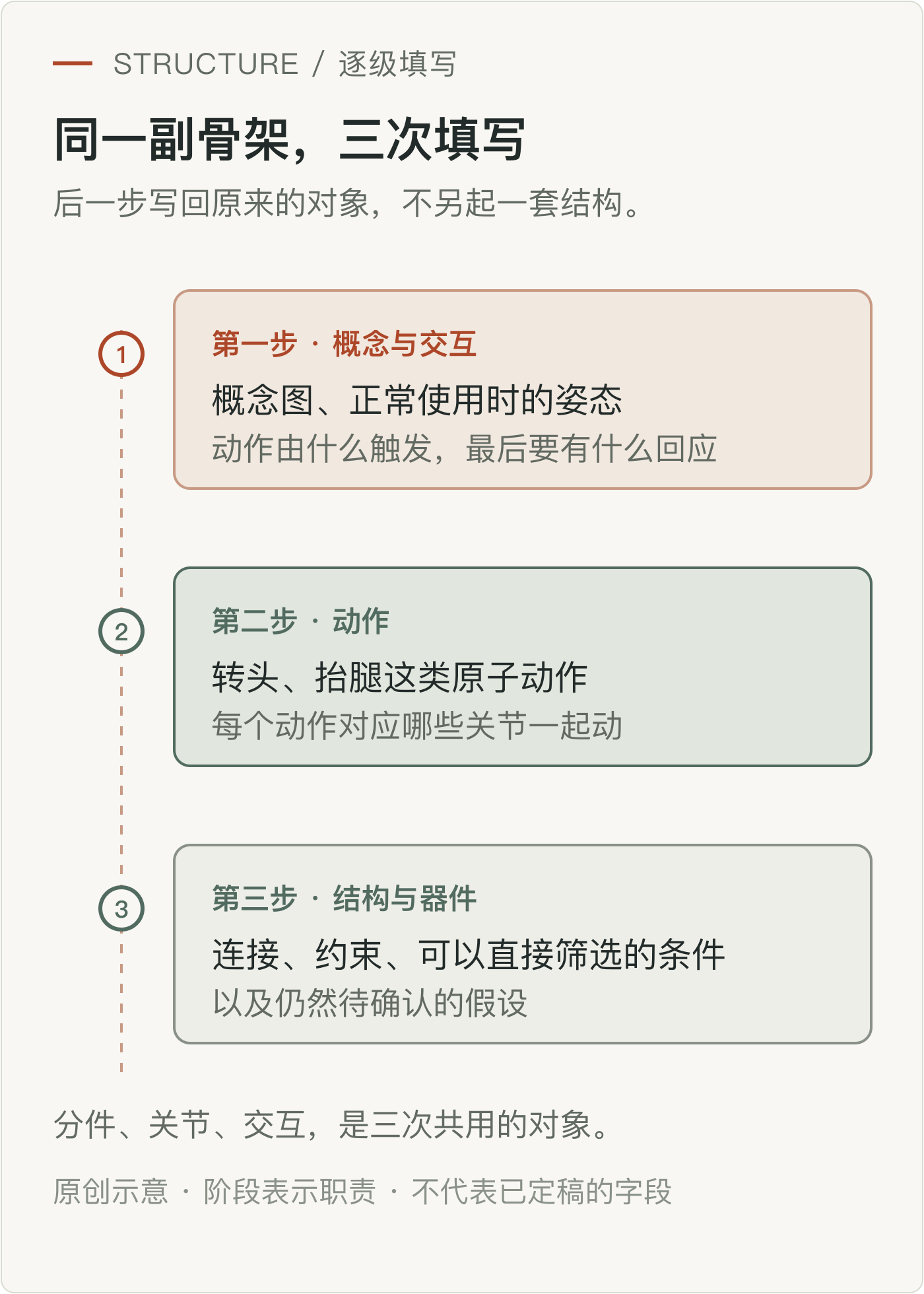
The three passes write to the same objects. The stages name responsibilities; the actual process can move back and forth. Original diagram, not a finished data definition.
This matters because a model generating a long set of fields has to stay consistent across a long span. The longer the span, the harder contradictions are to see. Breaking the sequence into short pieces gives an error a chance to stop locally. Someone explained it with probability: for a sequence of length L, the chance of getting all of it right falls as the length grows. I did not check the derivation at the time. The practical version is more direct: have it fill in blanks, and let a person set the questions.
People decide the names, enumerations and hierarchy of the fields. A model may draft a passage of natural language. A person confirms what it means. Values the user stated and values the system inferred must stay distinguishable. The more fluent the generation, the more this distinction matters. A model should not both set the question and grade its own answer.
Let the description walk back
What actually changed my judgment was the way of checking it.
Instead of asking whether the fields are complete, make a round trip. Give the product image and the user request to a fresh window and generate the fields. Open another window, give it only the generated result, and see whether it can say the concept image and the interaction again. If a different model can also read it, the fields are acceptable.
“Equal” has a concrete meaning here: the concept image can generate this structure, and this structure can return to the concept image. It turns “complete” from a feeling into a check that can be repeated.
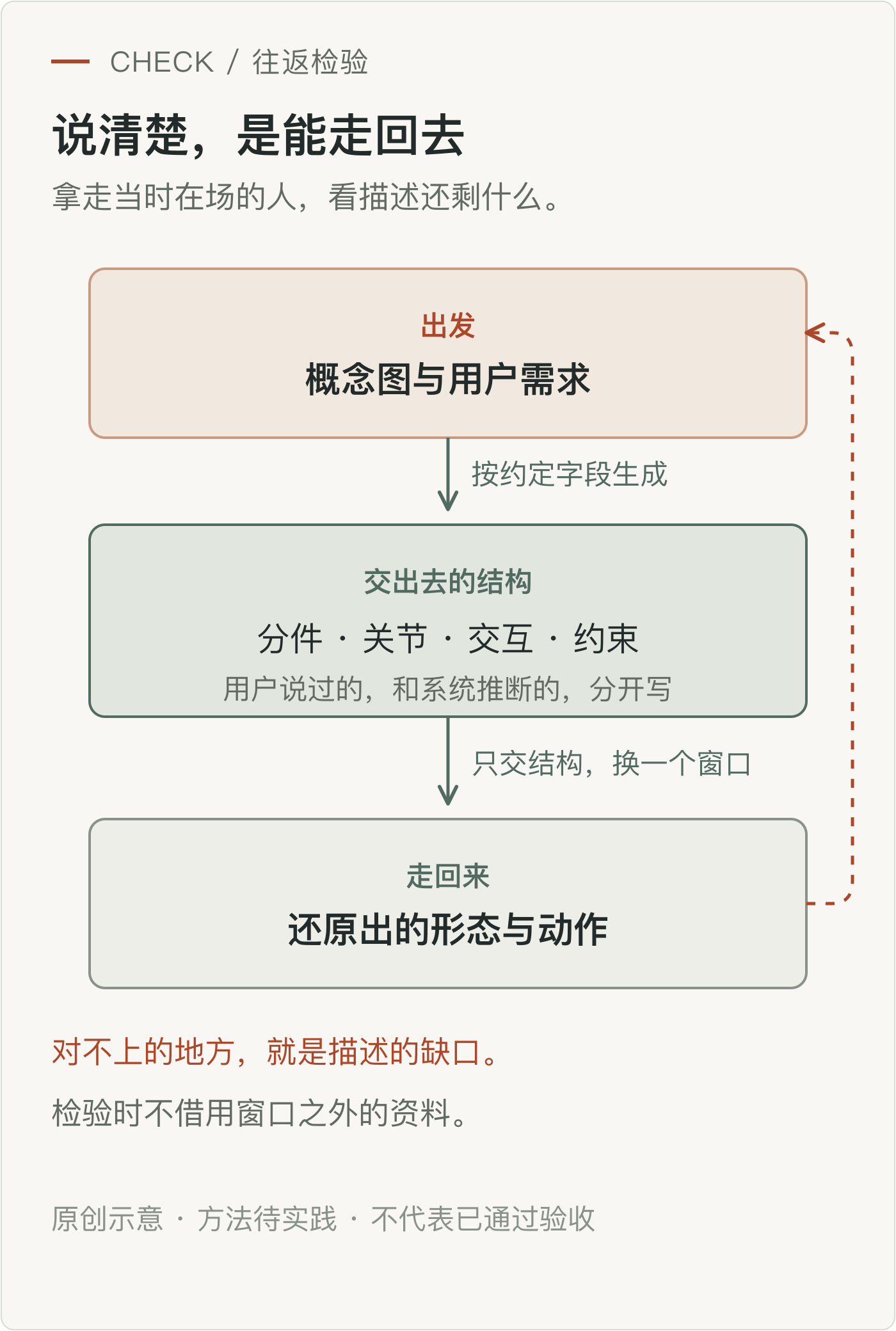
The round trip checks whether the information is equivalent. Reconstruction does not borrow material from outside the window. Original diagram of a method that is not yet a formal acceptance process.
The check does not allow web search. Otherwise the model can copy an existing product's documentation, appear to answer everything, and never read the description we handed over. What is being tested is whether the information is equivalent.
I used to treat “saying it clearly” as expression: write down what I know, and it is clear. I would now rather treat it as a relation. Can this passage let someone else rebuild what is wanted while I am not in the room? If only the writer understands it, that is familiarity.
A reverse reconstruction needs one more look. A model may complete a familiar robot from common knowledge, and an omission stays hidden for a while. So it should point to the basis of each reconstructed item: what came directly from the input, what was inferred, and what cannot be determined. Looking similar answers only part of the question.
A condition can also be changed, to see whether the change travels through the range it should. If allowed network access becomes a requirement to stay offline, do capabilities that depend on the network need another look? If the battery changes, which selections and layouts reopen? If an interaction is removed, do the components added for it still have a use? The round trip checks what the expression lost. The change checks whether the dependency was actually established.
Agree on the viewpoint before the numbers
The discussion of dimensions had a typical argument. Length, width and height look like the most precise description. When the viewpoint is not agreed, the three numbers can each be valid and still fail to fit together. Concept images are often drawn at an angle. Lay the same part on its side, and the three axes change meaning. Someone who must generate a structure from those numbers may not be able to read a definite form from them.
Another way of writing is natural language: a mushroom-shaped cap about two centimeters tall, with a radius of about so much. It states where the viewer is looking from.
At first I took this as a retreat. Later it seemed closer to the actual order of engineering. Image first, then abstraction. The whole first, then the part. Images and video are the most concrete, then words, then workflows, and only then code and numbers. By the time a component is selected, the comparison is often whether two passages are talking about the same thing.
Numbers become usable once they carry a reference. So the viewpoint, the origin and the front face have to be agreed first. The front can be the face a person meets when the product is placed in its normal use. These agreements produce no parts, yet they decide whether later parts can be assembled.
Joints are the same. Writing only “there is a rotation here” may leave a reader unsure whether this is a leg or a section of body that swings. Which parts a joint connects, which axis it turns around, and what motion it allows belong with its role in the whole.
A field is settled in a shell, a board and a bill
How a device gets onto a network sits near the front of a product definition. It keeps affecting what follows: how firmware is loaded, how low the power can be pressed, which module is chosen, whether the enclosure must leave room for an antenna, and whether the device must be registered and a domain written in before it leaves the factory. A user may only say, “I want it to keep me company.” On the hardware, that sentence becomes handing a wireless network to the device over Bluetooth, or a card that is paid for every month.
Users often do not care about the underlying protocol. The decision still exists. It moves somewhere invisible, and the structure, the cost and the yield carry it. The practical limit can be confirmed first: it must work offline, or a phone may take part in setup. What is worth asking early is a condition that would cause a large amount of rework if guessed wrong.
The discussion of microphone channels brought this down to search. The request had already stated the number of channels, but the result had not been narrowed by that condition. A parameter existing in a document, and a system being able to reject unsuitable components with it, still have a piece of work between them. A condition used repeatedly for filtering needs to become a field that can be queried directly, with its unit, meaning and source kept. Relevance can help find candidates. Whether a component can be used still has to be checked item by item. Two components with similar descriptions may fail exactly on power or interface.
Whether a field should remain can return to the same question: what judgment will the next person make with it? If it takes part in neither filtering nor checking nor correction, its necessity deserves another look. If a condition decides whether a component can be used, hiding it inside a long description leaves the later process without a basis.
Every constraint is settled somewhere: in a shell, on a board, on an invoice. Writing one enumeration wrong may cost another set of tooling.
Being rebuildable is the entrance
After assumptions and unknowns are written clearly, the person using the system still needs to be able to see that it has misunderstood.
Drawing a box to choose a part, mapping an action to a joint, and watching an animation of the motion bring out the explanation hidden in the structure. A head turning the wrong way is easier to point out than a long stretch of fields. Each step should answer a concrete question: how the body was divided, which joint moves and when, and which component a requirement landed on.
I also do not want the user to confirm every field. Clicking next again and again becomes a habit. The place worth stopping is where a guess could change the purpose, a key constraint, or a large amount of later work. The rest can unfold first as candidates, then be tightened by checks.
Fields can say what is wanted. They do not guarantee that a structure generated from nothing will reach a deliverable quality. A simple part can be tried. A whole machine is hard. The steadier path is to find a close structure in an existing library and add to it or subtract from it. Being rebuildable means the description kept the intent. Geometry, motion and the physical object still need their own evidence.
Writing this, I think again of the quantity field that was crossed out. It put a quantity that is always one into a place other people would read. It was removed because some certainties should stay in a person's hands.
My requirement for “saying it clearly” has therefore become small. Can what I say let another model, or another colleague, rebuild the thing to be made while I am not in the room? If it can, one fewer field does not matter. If it cannot, more fields are only my own notes.
Before the first field is written, there is an earlier question: who is this for, and why would they want to use it? Facing an actual user, I need to know which stretch of difficulty the system removes, which choices remain theirs, and whether they can see an error and change it.
When I review a generation process later, I want to carry the original request to the end: where it became explicit, where an assumption entered, and where evidence changed it. Then I want to walk back from the final proposal and see whether each important choice still has a way home.
When those ways home can be seen, a revision has a chance to leave the next judgment on firmer ground.