
REFLECTIONS
Write it down.
Think it through.
Judgments still taking shape, on reading, engineering and choices.
Keep the questions, and room for the next revision.
Your attention shapes your questions
After a recent conversation with a friend, the sharpest thing on review was not what they said, but what I ended up asking.
/ Reflections 02
Keep the core small, keep the judgment
At AI Engineer Europe 2026, Mario Zechner, the author of pi, explained why he made the core of his coding agent small in a talk called Building pi in a World of Slop. The most counterintuitive part is the system prompt: just a few lines.
/ ReflectionsLet understanding remain: from a concept image to engineering constraints
On the whiteboard there was a very short field: Part Quantity.
/ Reflections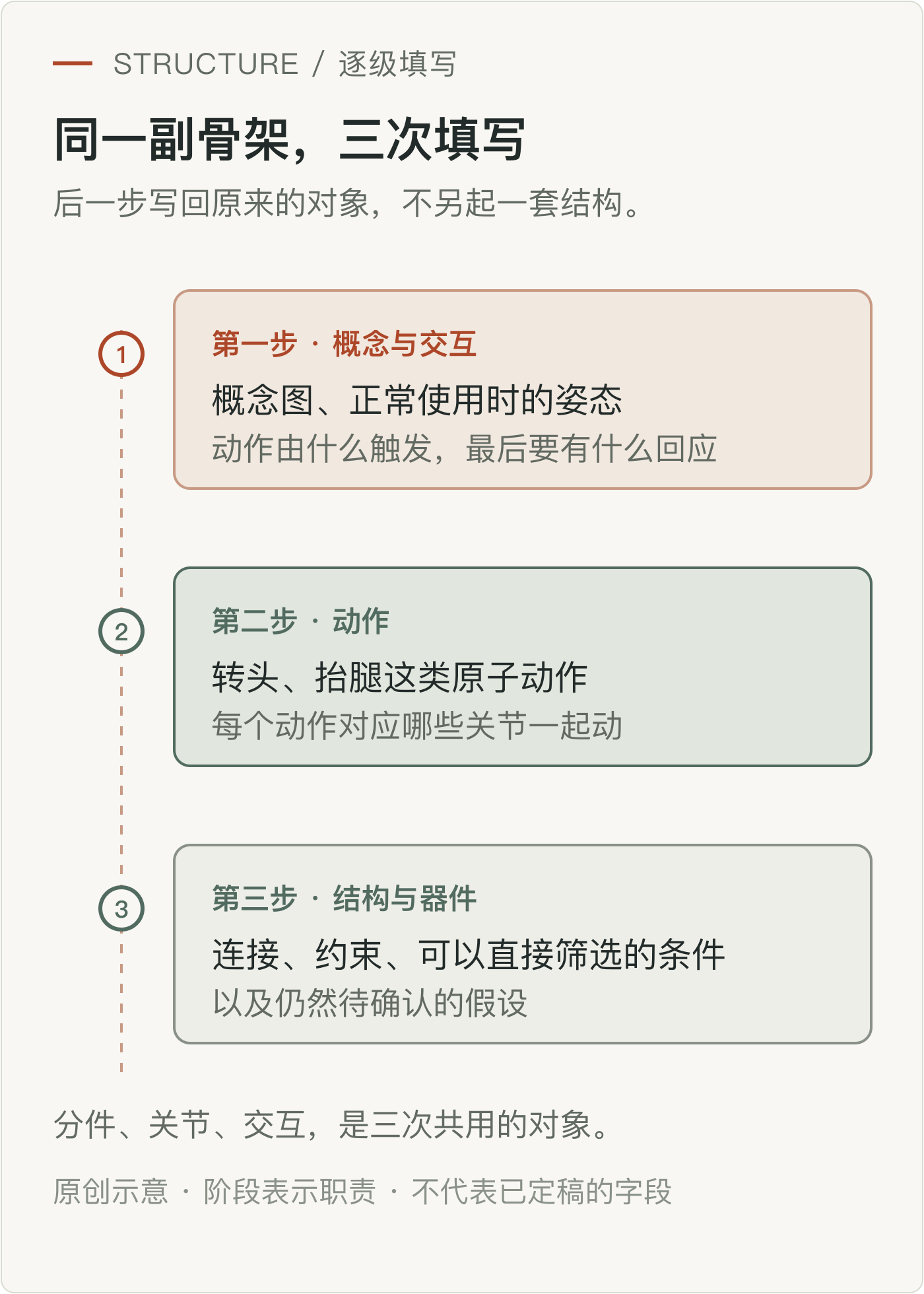 04
A path we shared still needs a new agreement
Some places stay lit after we have moved away. It is easy to feel that, as long as the light remains, the path can continue as it always did.
/ Reflections 05
Thinking in functions: making design decisions transferable
While discussing assembly CAD for a robot, one small question kept returning: a servo had been selected, but the next stage still did not know which part it was supposed to move.
/ Reflections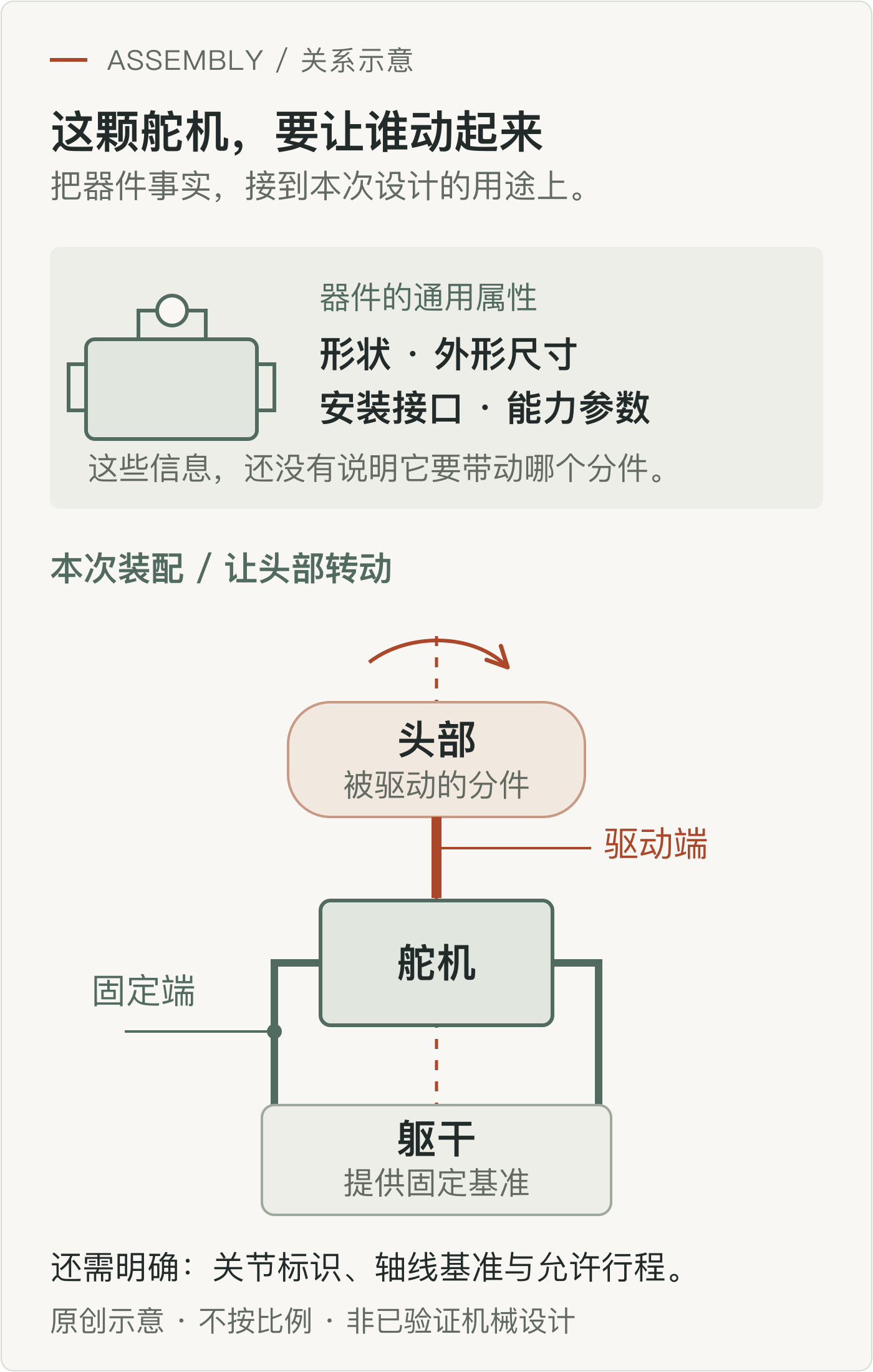 06
Entropy is an exchange rate between two worlds, not their currency
My earlier formulation divided the world into matter and information: the former carried by energy and constrained by free energy, the latter carried by information and updated through Bayes. Both capture principles of optimality that do real work. But putting them in parallel sentences makes two different kinds of claims look equally testable.
/ ReflectionsRereading a decision across three timescales
When reading a biography, I want to move beyond what happened at a particular moment and place key choices within three timescales.
/ ReflectionsTransfer capabilities, not labels
I am interested in possible connections between hardware practice and future space missions. But both being hardware is not enough to prove experience transfers directly.
/ ReflectionsSupport someone without setting their timetable
When offering help, it is easy to bind our own investment to an expectation of someone else's action. We prepare a great deal and hope someone will begin; we see a possibility and want it to happen soon.
/ ReflectionsBetween exploration and execution, keep the ability to reopen
Explore by increasing entropy; execute by reducing it. Anneal in cycles.
/ ReflectionsLet capability leave verifiable traces
When looking at someone's work, I want to know how they made something move from vague to concrete.
/ ReflectionsLet the distance guide you; let the present be tested
My long-standing interest in space begins with a distant question: how far can humanity go, and how much might that let us learn about the universe?
/ ReflectionsOutcomes grow in context
When evaluating a piece of content, we easily credit its performance to the creator's ability. Yet content never happens alone.
/ ReflectionsA decision's weight also lies in its frequency
The most visible decisions are often those hardest to reverse. A shop needs a location; a startup needs a direction. One choice can affect a long span of time.
/ ReflectionsLeave a framework room to change
I want a cognitive model that accumulates practice and guides the next choice. But the more complete a framework becomes, the more I need to ask whether it has shown me something I previously could not see.
/ Reflections