
Thinking in functions: making design decisions transferable
While discussing assembly CAD for a robot, one small question kept returning: a servo had been selected, but the next stage still did not know which part it was supposed to move.
The model number, dimensions and 3D model could all be passed along, yet the work would still stall. This made me reconsider what it means to think in functions: each stage needs to turn the decisions it has already made into inputs that let the next stage act. Whether a design can move forward depends on whether those decisions have been carried across.
What should this servo do in this design?
Component documentation tells us what a servo is capable of. It can serve different mechanisms and produce different movements. After selecting a model, we still need to explain its particular role in the design at hand.
Consider a robot turning its head. The assembly system needs to know which joint the servo serves, which part holds its housing, which part its output shaft drives, which reference frame defines its axis and mounting surfaces, and what movement is allowed. An identical servo elsewhere may have a completely different job.
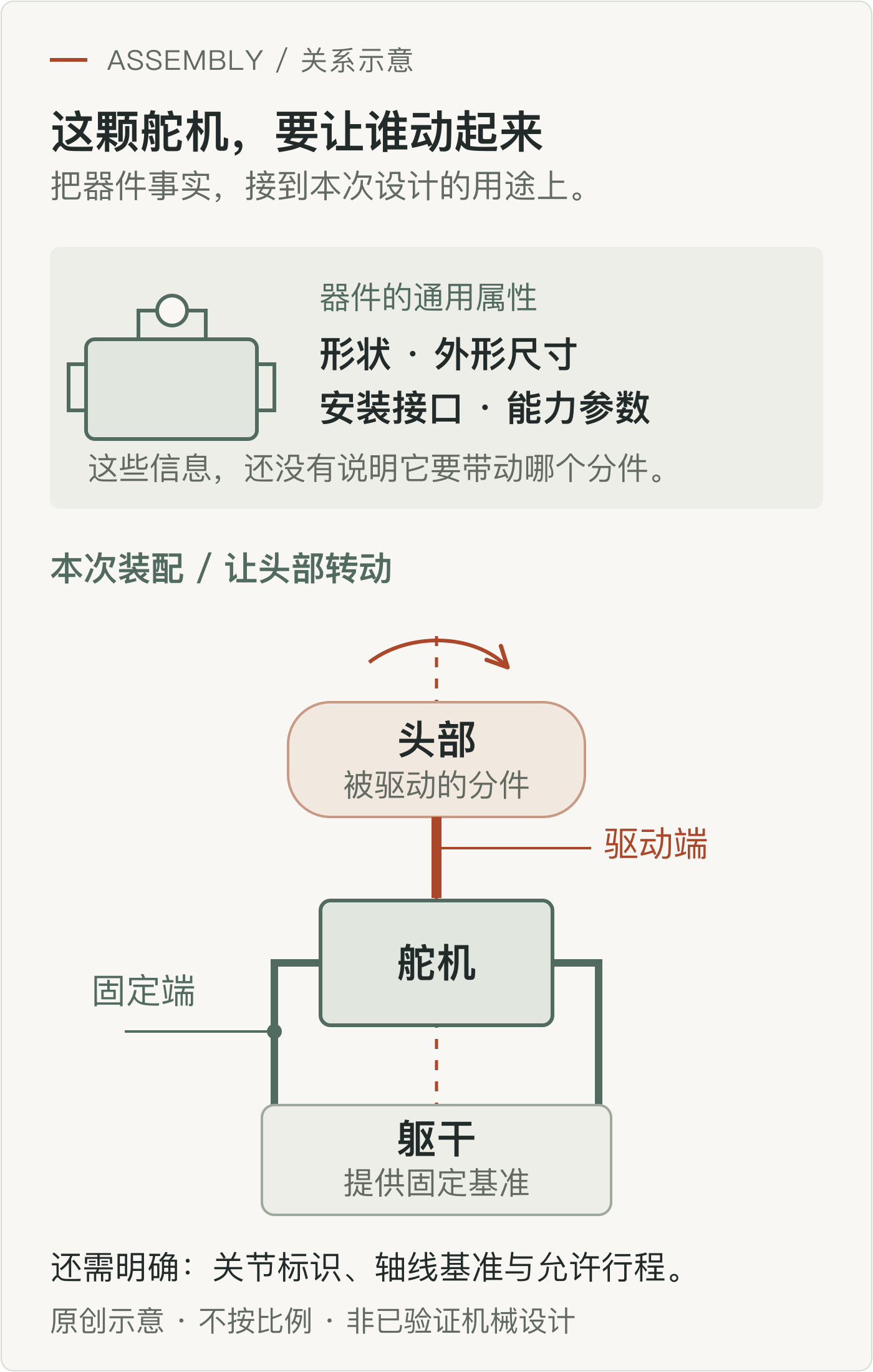
What a component can do and what it is responsible for in this design must travel together. Original relationship schematic, not to scale and not a validated mechanical design. Labels in the original figure remain in Chinese.
If we pass on only a component ID, the next stage must return to the requirements, read a conversation, or guess again. Context left out of the input still affects the result; it simply becomes difficult to inspect later.
I understand a function boundary first as a place where decisions are handed over. We should be able to say which matters are settled at this point and which remain for the next stage to choose. This gives a division of work a concrete meaning: the material I give you is sufficient for you to complete the agreed part of the task.
This boundary also leaves room for unknowns. If the axis has not been determined, keep it as an open problem. A coordinate that appears complete cannot stand in for a decision that has not yet been made.
Clear relationships give positions something to be solved from
Once we explain how the servo connects the torso and head, finding its position no longer requires aimless trials across the entire space.
The axis driving the head constrains the servo's orientation, and the mounting interface constrains its position relative to the torso. A camera must align with an opening in the shell and has positioning requirements of its own. A battery may retain more freedom, while still being constrained by available space, connections and other stated conditions.
I would therefore specify connections, mounting references and permitted movement first, then seek a feasible layout for the remaining degrees of freedom. Relationships are established first; coordinates can be the result of solving them. If the shell's dimensions change, the old coordinates may cease to work while the intention—this servo turns the head about this axis—can remain.
This also changes how I see a layout search that keeps trying without finding a result. Some computation explores genuine alternatives. Other computation tries to supply decisions an earlier stage never specified. When the two are mixed, search slows down and it becomes hard to identify what actually failed.
Thinking in functions can help turn existing decisions into constraints, rule out invalid placements, and reserve computation for the choices that remain. Even seeking a single feasible solution requires us to state what counts as feasible.
But obtaining coordinates still leaves work to do. The next stage must also understand why these positions hold and what changes could invalidate them.
Let changes propagate along dependencies
Suppose we replace the servo with a model whose mounting holes are spaced differently. The old bracket may no longer work, but the task of turning the head need not be redefined.
If the system preserves these dependencies, it can regenerate the bracket and holes from the new mounting interface, then check the space they occupy and the clearances during movement. Decisions affected by the change reopen; design intentions that still hold carry forward.
I want CAD to preserve the conditions under which a shape works. Why a bracket hole is here, why space must remain clear in a certain direction, and why a position cannot move should be traceable through relationships to a purpose, interface or constraint.
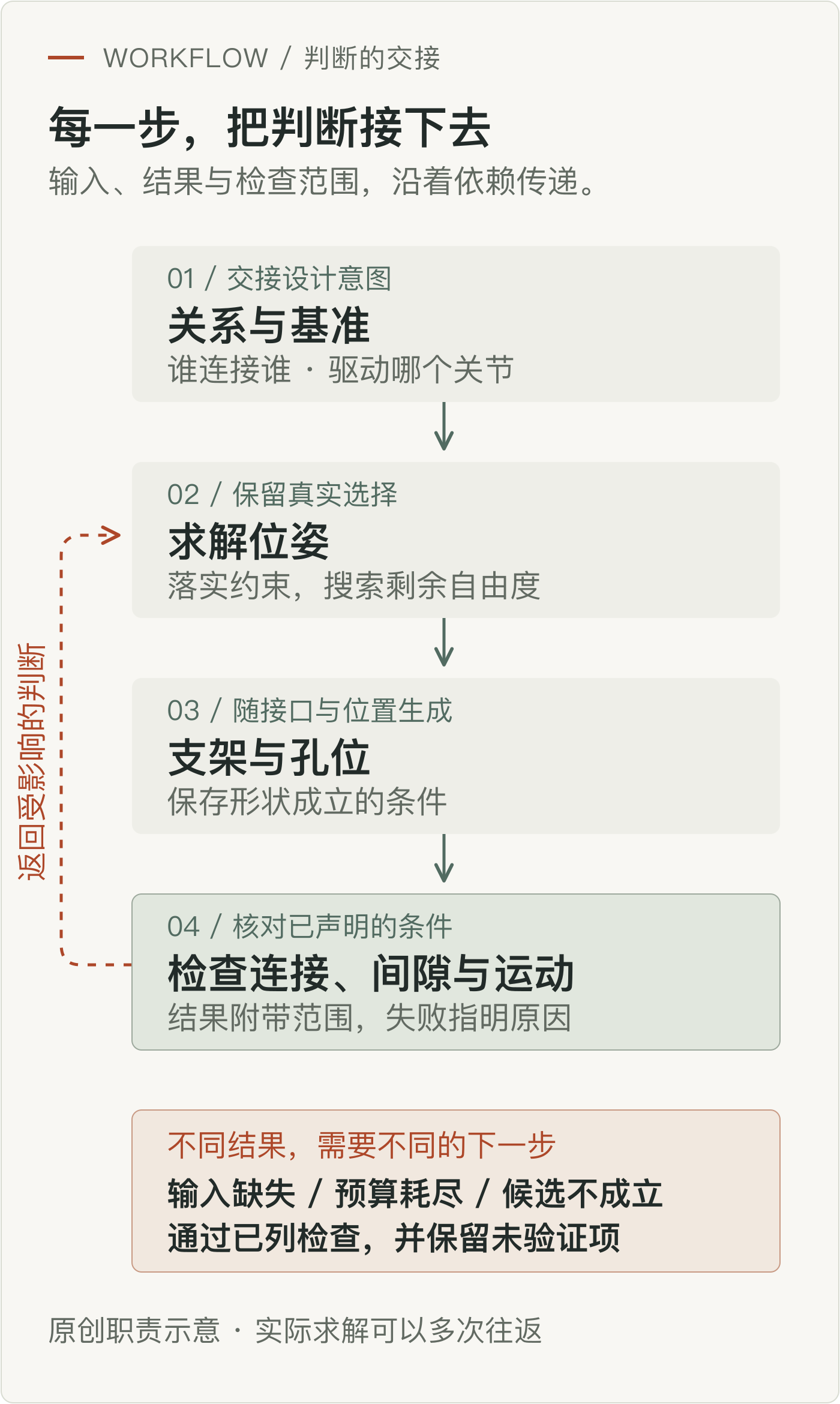
Generation and checking connect through explicit results. Returning to an earlier stage should target the affected decisions. These stages express responsibilities; an actual solver may revisit them many times. Original workflow schematic; labels remain in Chinese.
A modification then becomes a test of how the system is organized. When the servo changes, what changes with it? What remains untouched? If we must explain the whole robot from the beginning every time, earlier design decisions may not yet have been preserved in a usable form.
This does not require assembly to become a pipeline that never goes back. A generated bracket may consume space reserved for the battery, and a movement check may invalidate the previous layout. What we need to preserve is an explicit path back, so a failure can point to the decision that produced it.
Pass failures on, too
Returning a model makes it easy to believe the work is complete. Yet successfully generating the model, getting connections right, avoiding interference over a specified range of movement, and making hardware work reliably each require their own evidence.
For the servo driving the head, fitting in a stationary pose answers only a question about that pose. We must still check whether the head hits the shell as it turns. If only a few poses have been checked, that scope should remain visible; unexamined regions cannot quietly be counted as passing.
I therefore want each stage to deliver both its result and the scope within which it holds. Constraints checked, information missing and matters awaiting confirmation all belong in the output.
Failure needs the same precision. A missing joint assignment means the input is insufficient. Interference in one candidate means that candidate needs revision. Failing to find a feasible layout within a time budget means this search has not succeeded. Only when all possibilities within the permitted domain have actually been ruled out can we go further and declare the problem infeasible.
These distinctions determine whether the next step should supply information, choose another candidate or adjust the search. A clear failure can reduce blind trials in the next round. A vague success may let unresolved problems travel further downstream.
One less guess, one less downstream cost
Viewed through my understanding of cost and updating, the connection between information and the material world becomes concrete.
An unspecified answer to “which joint does this servo drive?” begins as missing information. Further along, it may become extra search, an incorrect bracket or a wasted print, finally surfacing during physical assembly. A decision skipped upstream can reappear as a cost someone must pay later.
Conversely, checking gives an update a specific target. A collision can rule out a layout candidate; a new mounting-hole spacing can trigger bracket regeneration. When we know which decision the evidence changes, revision has somewhere concrete to land. This need not yet be expressed as Bayesian computation, but it gives “revise in response to feedback” an executable meaning.
Defining interfaces and constraints has a cost, of course. I care more about whether that expenditure buys less repeated explanation and a shorter path back to the source of an error.
When reviewing such a system later, I want to follow the servo again: where was its purpose established, what survived the handover, which conditions determined its position, and how did we establish that it could perform its movement? When something failed, I also want to know which earlier decision changed because of it.
When the next stage can carry forward the understanding already reached by the previous one, a design has a chance to accumulate through repeated revision.
This essay grew out of a discussion of robot hardware layout and system architecture. The servo and head-turning example illustrates how decisions are handed over; both figures are original schematics. The generation and checking methods discussed here express an engineering interpretation, not a design that has completed physical acceptance testing.