
Einstein: the wealth of curiosity
What I envy most in Walter Isaacson’s Einstein is how someone could remain interested in the world for so long, and in such specific ways. At sixteen, Einstein imagined what he would see if he caught up with a beam of light. His life kept changing, but that question stayed with him. He also played the violin, argued about philosophy with friends over inexpensive dinners, and could be passionate, stubborn, evasive and hurtful in intimate relationships.
These details make him feel, first of all, like a living person. His engagement with the world is deeply appealing, and it also reaches into the lives around him. The more I envy that pure curiosity, the more I want to understand how it stayed with him, and who bore the costs of allowing it to continue.
A question that did not expire
Roughly ten years separate the sixteen-year-old’s question about light from special relativity at twenty-six. That span moves me. We often give something days or weeks before deciding whether to continue. He carried a question through education, love, job hunting and earning a living.
Of course, the connection between the youthful thought experiment and the eventual theory comes largely from his later recollections. Once we know the ending, it is easy to turn that beam of light into a road that was already laid out. What I want to learn from is what happened repeatedly in between: reading existing theories, noticing their conflicts, taking a difficulty into conversation, and returning to revise the question. Eventually, he examined even the apparently settled background assumption of simultaneity.
A question can remain with us for years while our understanding of it keeps changing. Repeating an initial feeling for a decade could turn curiosity into a flattering story about ourselves. Einstein made his difficulty more specific, until it placed definite demands on established ideas about space and time.
I once wrote down the word “attention.” Here I feel its weight more clearly. Attention includes the ability to work for several uninterrupted hours, but also the willingness to return to the same question after life has taken us elsewhere. We may leave the desk for a while without letting the question expire.
This also changes how I think about self-assessment. After graduation, Einstein could not find a permanent position. His applications often received no reply. He became discouraged and wanted recognition. He was affected by other people’s judgments. Yet failure to find a position did not entirely decide which questions he considered worth pursuing. Before the outside world had made room for him, he was still making room for his questions.
That inner judgment is precious. It allows someone to keep working before rewards arrive. A question can wait ten years, though; rent and daily life cannot wait indefinitely.
Curiosity needs somewhere to live
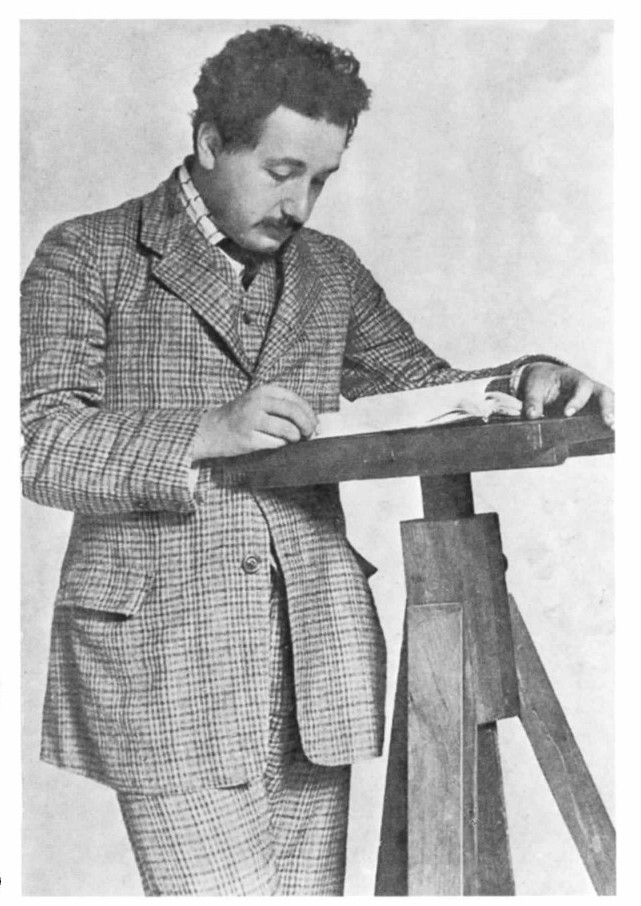
Einstein at the patent office in Bern; the book dates this photograph to 1905. From the photographic plates in Isaacson’s biography.
Private tutor, temporary teacher, patent examiner: beside his later fame, these roles can look like passing entries in a résumé. At the time, they determined how he could support himself, and whether tomorrow would leave room for thought.
Through his father, Grossmann helped Einstein find the opportunity at the patent office. The job provided a more stable income and required careful judgments about how technical claims actually worked. As he became familiar with the work, scientific thinking could enter the gaps in his day. Accounts of his finishing official duties quickly and slipping research notes into a drawer have the character of later recollections. What can be established is that he was still a patent examiner with a regular job when he produced the papers of 1905.
I see the practical conditions that sustained concentration. Willingness to devote oneself fully is not enough on its own. Life must remain viable, and attention needs chances to accumulate. Without a job, uncertainty could weigh on the same person. As income and routine became more stable, longstanding questions could more easily receive continuous time.
So I am reluctant to reduce his experience to the claim that people who truly love something will always make time for it. That underestimates the resistance of daily life and treats enabling conditions as a resource of willpower available to everyone. Einstein had extraordinary powers of concentration. A friend’s recommendation, the arrangement of work, and support from people around him also changed his circumstances.
Nor did concentration mean he needed only solitude. In those hours outside work, he needed people with whom he could keep a question alive in conversation.
People who could meet the question
I once summarized his intellectual company as a circle without ordinary minds. Names such as Planck and Hilbert make it easy to envy that environment. But concentrating only on people who became famous misses something more interesting in his early life.
The “Olympia Academy” in Bern began as a few young people reading, eating and arguing together. Solovine originally came in response to Einstein’s advertisement for physics tutoring. After several meetings, paid lessons became free conversation, and Habicht later joined them. They read philosophy and science, and made fun of solemn academies. That intellectual life had pleasures of its own, without first having to prove its usefulness to a future paper.
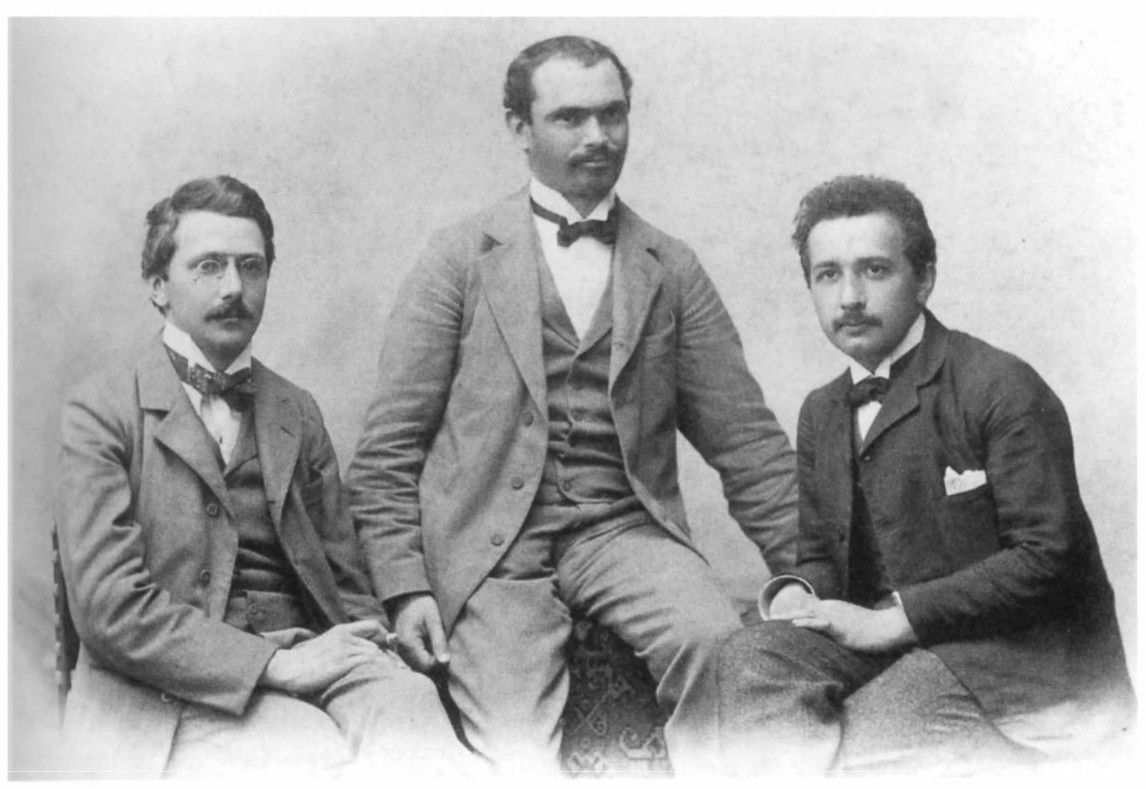
The three friends of the “Olympia Academy,” dated by the book to around 1902: Habicht, Solovine and Einstein, from left to right. From the photographic plates in Isaacson’s biography.
Such company allowed a question that had not yet won recognition to receive serious attention. Besso could help Einstein work through difficulties; Grossmann later helped him enter the mathematics needed for general relativity; Planck took an early interest in his work on special relativity; with Hilbert, admiration and competition coexisted. Each relationship offered something different.
Around 1912, Einstein began seriously drawing on advanced mathematics he had once undervalued. That change suggests an appealing form of confidence: believing a question deserves pursuit while recognizing that one lacks the tools to pursue it further. Commitment to a goal can coexist with respect for other people’s abilities.
What I want to take from these relationships is another way of recognizing companions. Who will try to understand something I cannot yet express clearly? Who can point out a difficulty I have skirted? And can I make room for their questions too?
That last question becomes especially heavy when I read about Mileva.
She once had questions of her own
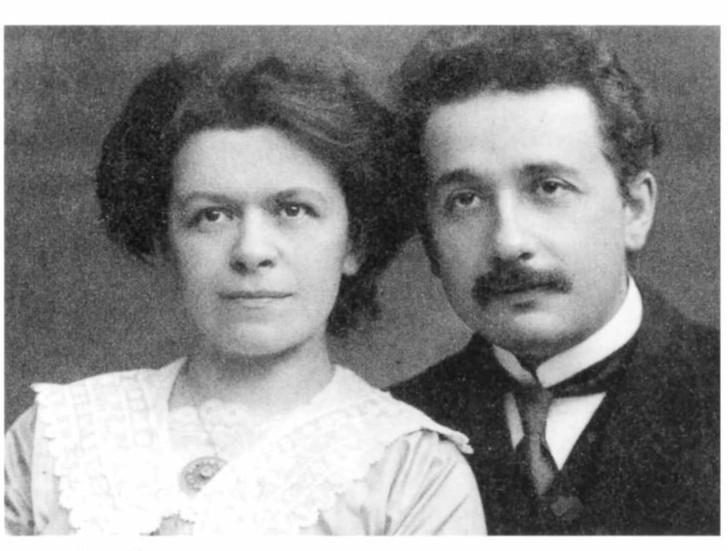
Mileva and Einstein; the book dates this photograph to around 1905. From the photographic plates in Isaacson’s biography.
They had initially imagined a life in which they could be lovers and also read and discuss physics together. Mileva had an education and scientific ambitions of her own. She entered classrooms that were difficult for women to enter, and hoped to make a place for herself there.
The book examines her role in Einstein’s early work. Discussion, checking calculations and proofreading must be distinguished from contributing original theoretical ideas. The phrase “our work” in intimate letters is not enough to establish joint authorship of a theory. Equally, the absence of her name on the papers does not erase her presence in their shared life. Isaacson reviews that controversy; my task here is to preserve the boundary of what the evidence supports.
What matters more to me is how something they had both valued became an asymmetrical way of living.
As family life, children, moves and career decisions accumulated, he still had a question that was recognized and continually advanced. Her scientific ambitions became harder to pursue within their life together. From his side, concentration appeared as the exclusion of interruptions. From the other side, it could mean taking responsibility for what had been excluded. His uninterrupted thinking and her daily life that could not be paused belonged to the same household.
That asymmetry became very concrete in the conditions he proposed for living together in 1914. He required her to arrange his clothes, meals and rooms, while giving up many expectations of intimacy. The need for quiet research no longer adequately describes what was happening. One person’s research needs cannot alone determine how another person should live.
Counting only his personal sacrifices would leave the other side out of the account. Time, care and emotional needs do not disappear because a research question is great. They may instead fall to someone else. Having once wanted the same things does not automatically mean that both people will always be willing, or able, to sustain the same arrangement.
Yet Einstein was not without feeling. The book recounts him holding his children, telling stories and playing the violin to soothe them. When Mileva left Berlin with the children, he wept at their separation. Those scenes beside his harsh conditions are harder to sit with than a label such as “the cold genius.”
A person can feel deeply and still fail to respond well to others. Longing, pain and love can be real, alongside the harm done within a relationship. Between feeling and taking responsibility lies a distance that actions must cover.
I still envy his wealth
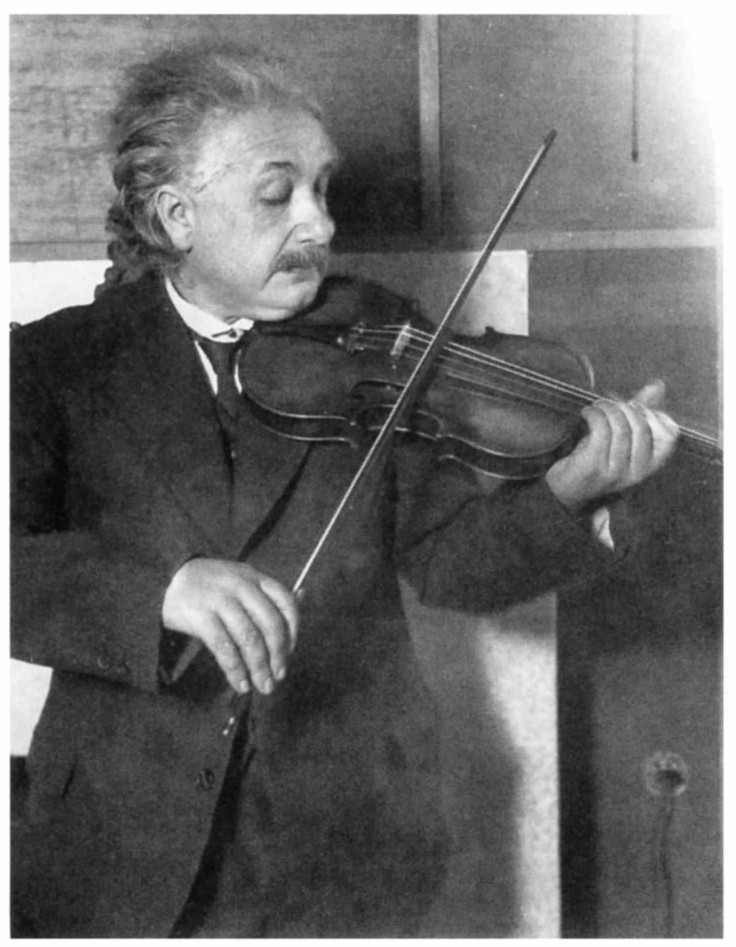
Einstein playing the violin. From the photographic plates in Isaacson’s biography; the book does not date this photograph.
For the same reason, I do not want to classify all the feeling in the book as distraction. The violin, friends, love and natural surroundings were the world he actually inhabited. As a student in Zurich, he heard a neighbor playing Mozart and ran over with his violin to join in. After discussions with friends, music could follow. Such moments show someone who did not need to wait for an answer before finding life interesting.
I am drawn to the idea that this responsiveness to the world was connected to his imaginative life. But there is no easily established causal chain from enjoying music to creating a theory. What inspires me more is that rigorous thought and abundant feeling can coexist in one person. A question does not lose its original wonder when it becomes expressible in mathematics.
After reading, I want to ground my own self-assessment more firmly in concrete questions. I want to spend less time deciding whether I am intelligent enough, and more time recognizing what I would still want to understand without applause, how much time I have reserved for it, and whether I have truly noticed what others contribute.
I want to protect that curiosity in a way that also leaves room for the wishes of those who share my life. Some of the resistance surrounding wholehearted commitment is systemic. It calls for joint adjustments to work, income, responsibilities and expectations. Asking one person to become better at enduring it is unlikely to sustain things for long.
I still believe curiosity is one of humanity’s most precious forms of wealth, and Einstein is the richest person I have come to know through reading. He could let a question accompany him across many years, and find such vivid pleasure in a melody or a conversation.
My envy of that wealth now comes with a clearer awareness: I hope to remain interested in the world for a long time, while cherishing the people who give that interest somewhere to grow.
Reading source: Walter Isaacson’s biography of Albert Einstein, in Zhang Butian’s Chinese translation. The light-beam question and early life are discussed mainly in Chapters 2–6; friends, family and the work on general relativity in Chapters 8–10. This essay relies on the biography, which draws on both contemporary letters and later recollections. I have not independently checked each underlying archival document. The interpretations of attention, shared life and cost are my own reading judgments.