
Liftoff: Turning Difficulty into a Next Step
Reading Eric Berger's Liftoff, what moved me most was how people returned a damaged rocket to the launchpad before its fourth flight. At that point, “believing in the future” was too broad a description. Someone found a transport aircraft; others improvised repairs in flight, removed an engine on a small island, or inspected welds. Distant Mars had become something urgent and tangible in each person's hands.
My reading notes return to optimism, money, quick decisions and taking responsibility. Looking back, they all lead toward one question: How can a person's response to difficulty make others willing to commit their own time and futures alongside them?
Eventually that question turned back on me. Faced with resistance, I readily explain how external conditions work against us. Those explanations may be valid, yet sometimes nothing has moved by the time I finish. The early team in this book made me consider another ability: understanding the constraints, taking hold of the problem, and enabling a next step.
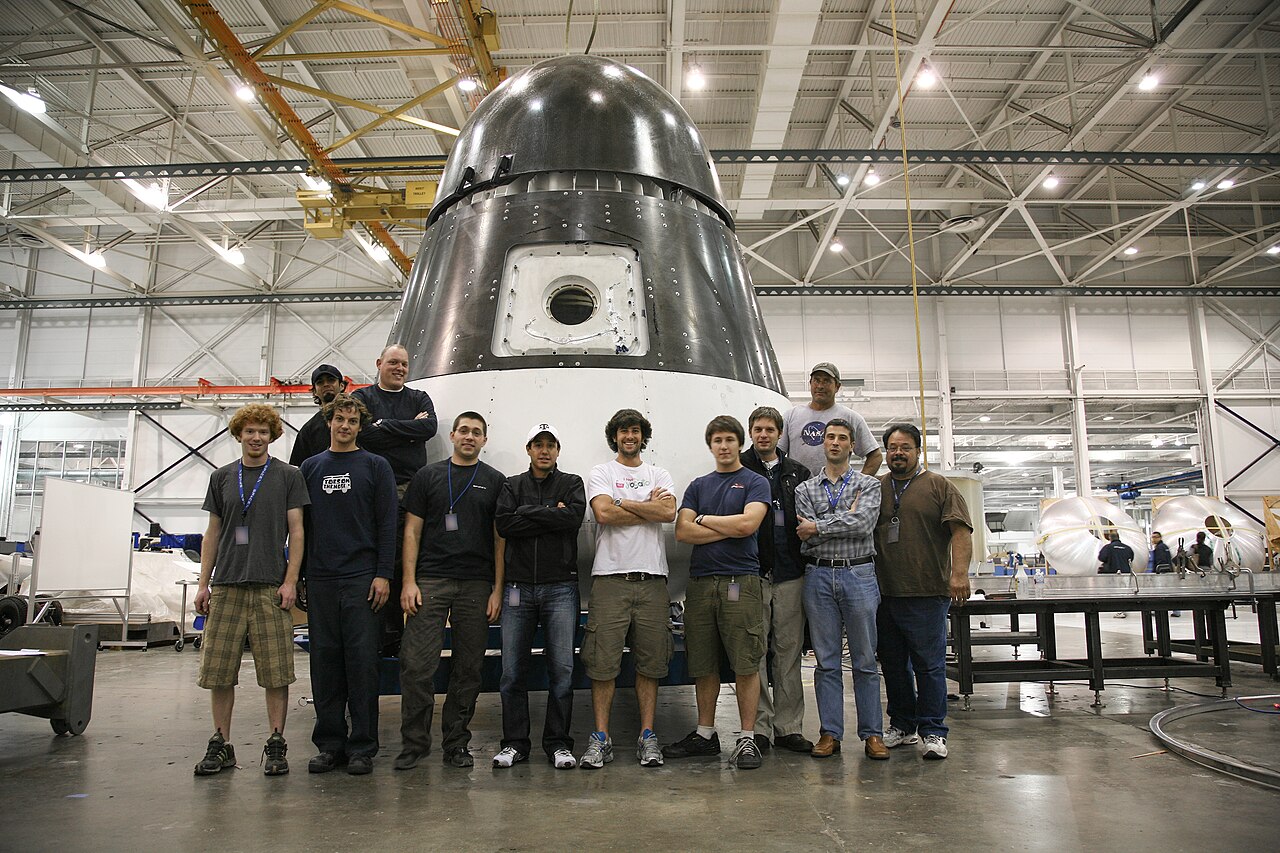
February 25, 2009: SpaceX engineers pose with a Dragon qualification unit in Hawthorne. This records the team’s working environment after Falcon 1 first reached orbit. Image: SpaceX, CC0. Source

First, help people stay at the table
On the evening of the first failed launch, Kimbal Musk borrowed a friend's yard on the island and cooked a hot meal. The team gathered around it. There was no elegant celebration: just people who had lost a rocket and would face its wreckage the following day.
In Kimbal's later account to Berger, Elon picked up on amusing details in conversation and kept developing them, making people laugh despite the weight of the evening. He was disappointed, but disappointment did not occupy the entire space.
I had written in my notes that optimism creates the future while pessimism avoids risks. Now I feel that thought needs another step. How optimism enters a room, or helps someone stay on the evening after failure, is more concrete than declaring oneself an optimist.
The meal could not change the failed flight. What it might change was whether people could work together tomorrow. People do not always need to overcome disappointment before beginning again. Sometimes they need company, food and laughter before turning to what comes next.
The book contains many such details. Steve Davis recalled betting with Musk about technical matters. Once, Davis put twenty dollars on finishing some tests by a deadline; Musk wagered a frozen-yogurt machine that he would miss it. A serious milestone also became something the whole team could look forward to.
This kind of encouragement appeals to me because it acknowledges that people need enjoyment. Schedules, purpose and pressure alone may not carry a group very far. Yet laughter has a boundary too: when bad news cannot be spoken seriously, a relaxed atmosphere becomes a performance others must join. The lesson of the third flight makes that clear.
Optimistic about the future, honest about the numbers
On the third flight, the first stage completed its main burn and the stages separated, only to collide again. The mission failed once more.
It was natural to suspect the separation mechanism. Mueller initially questioned the system Thompson was responsible for, and Thompson insisted on examining the data. Davis worked through the night on video and telemetry, identifying the crucial observation: after separation, the first stage was still accelerating.
The new engine used regenerative cooling. Propellant remaining in its passages produced a brief residual thrust, and the existing separation timing did not leave enough margin for the change. A local improvement met an assumption retained elsewhere in the system, and the two collided in flight.
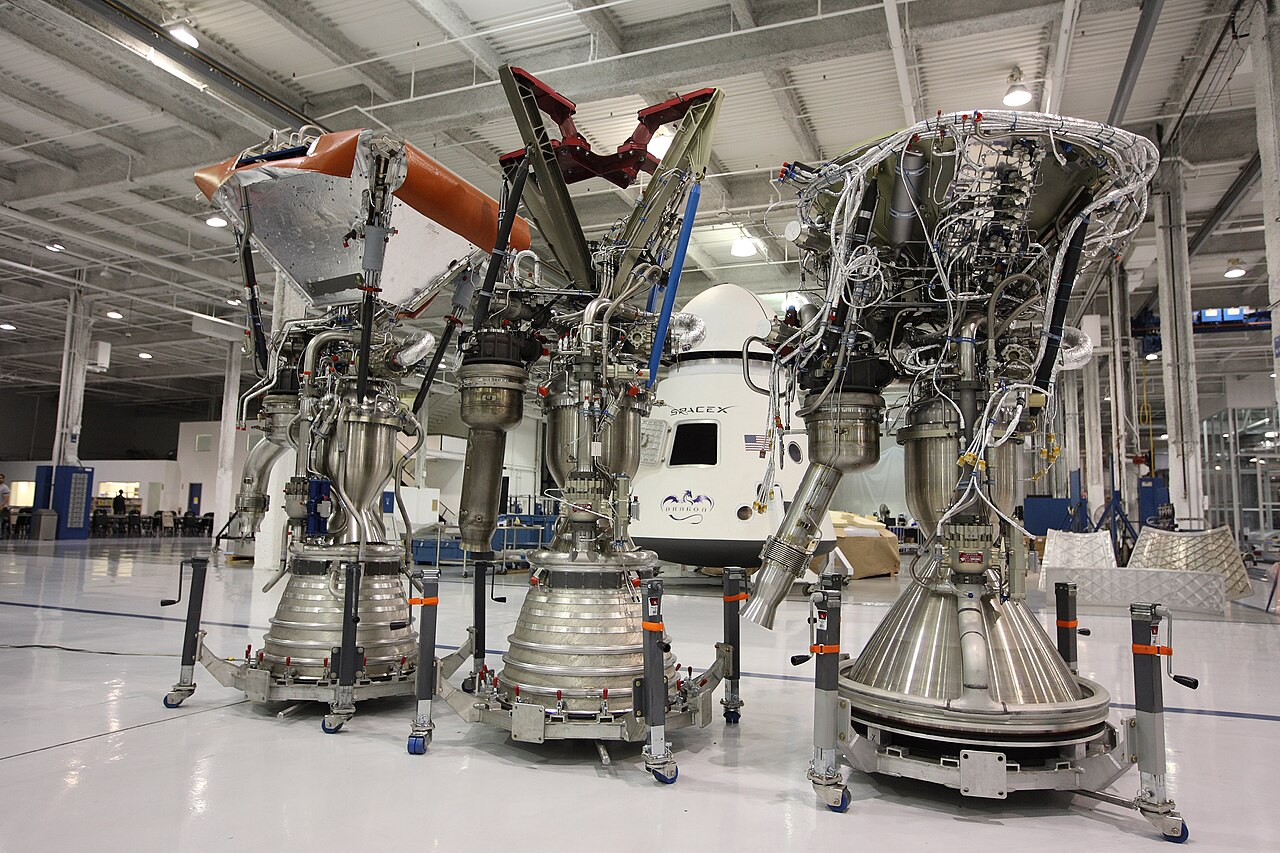
December 12, 2008: Merlin engines at SpaceX’s Hawthorne headquarters. The photograph shows the hardware and plumbing after the fourth flight; it is not a record of the third-flight failure. Image: SpaceX, CC0. Source

Here I noted that the precision of systems-engineering assessment determines the degree of certainty. More precisely, an engineering judgment needs to establish its basis, the size of its error, and the conditions it has not covered. “The engine has shut down” and “the stages can safely separate” appear to follow each other, but a physical process between them still needs measurement.
Optimism and caution can therefore belong to the same undertaking. Continuing to build rockets is a choice about the future; admitting that the data do not yet support a conclusion is a demand placed on present facts. Keeping these distinct allows enthusiasm to endure without avoiding the problem.
For the fourth flight, the interval between shutdown and separation was extended. That modification gave progress a plain, tangible shape: something missed last time was now written into the sequence.
But identifying a technical cause is not enough. Someone has to decide on the change, provide resources, and bear the consequences of another attempt.
At a critical moment, he could make things simpler
In the epilogue, Florence Li recalled that Musk's close involvement and timely decisions helped work move forward at difficult junctures. Hans Koenigsmann likewise emphasized his willingness to tackle the hardest problems without delay.
That experience matters to me. A leader's arrival may add another round of explanation, reporting and waiting, or it may help resolve what has become stuck. A team learns the difference through particular encounters.
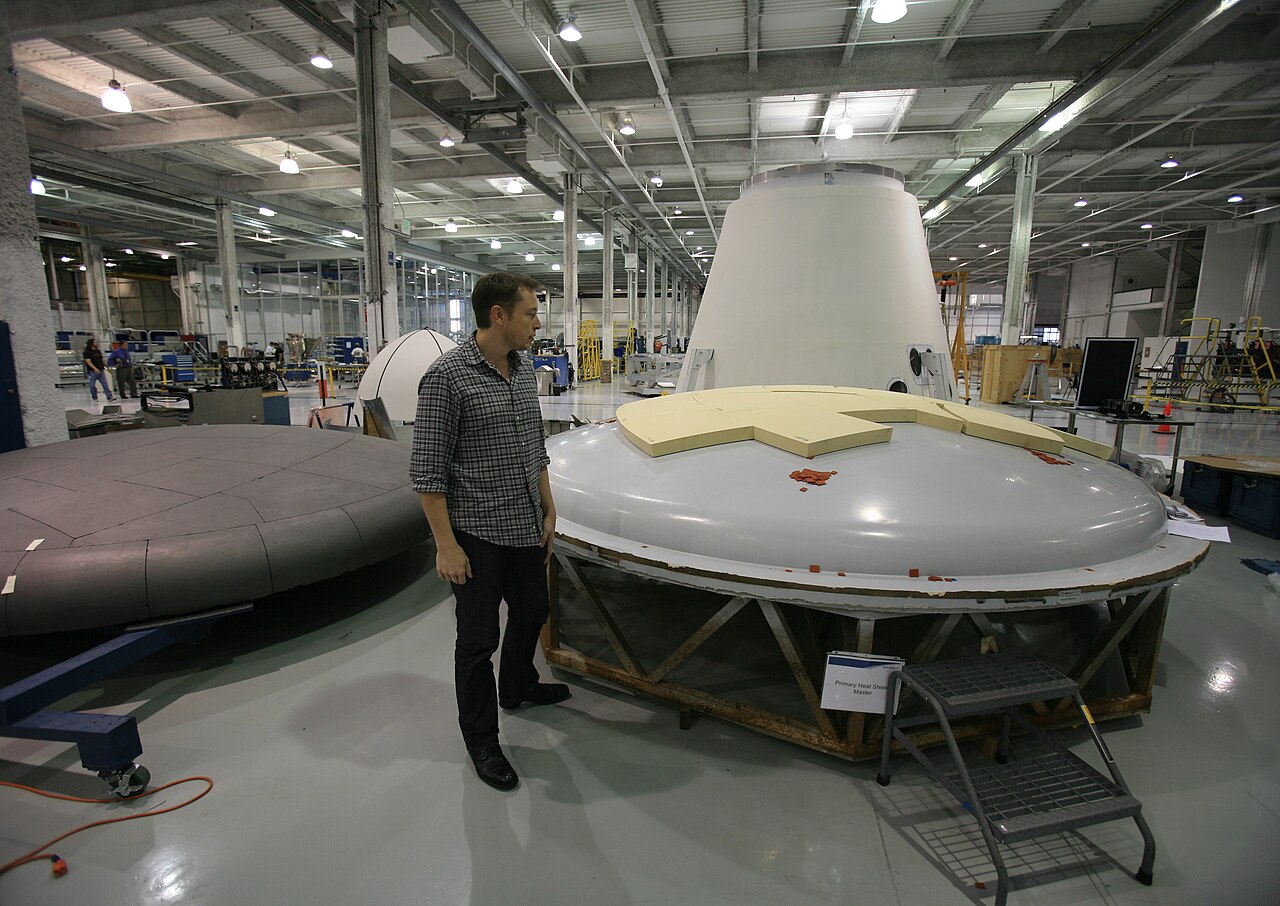
October 15, 2008: Musk examines a heat-shield assembly in the factory, after Falcon 1’s first orbital success. Photograph: Steve Jurvetson, CC BY 2.0. The source site’s proportionally reduced version is used without cropping. Source

Musk described one advantage in the book: he could judge engineering and spending together. Ordinarily, an engineer has to explain a purchase to someone who controls the budget but may not understand the technology. Combining relevant knowledge with decision-making authority shortened that exchange. Changing a supplier, buying equipment for a test, or deciding whether to pursue a design could follow directly from the discussion.
This changes how I understand quick decisions. Learning to urge others to hurry is easy. Understanding the problem, finding people able to judge it, and ensuring that resources accompany the decision are harder. If others must quietly supply the missing conditions after every pronouncement, apparent decisiveness may simply transfer work.
One of my notes asks: Musk holds technical reviews every week—what about you? Checking the book this time, I found descriptions of frequent technical discussions and deep involvement in engineering, but insufficient evidence for a fixed weekly meeting. The question still holds: how much sustained attention do I give the technical problems that determine whether something succeeds?
I do not need to know every answer. But I should at least understand where the team is stuck, what it has tried, and what the next judgment still requires. I want my involvement to reduce those unresolved questions.
Concentrated authority also makes mistaken judgments costly. After the first failed launch, the book describes Musk prematurely directing blame toward Jeremy Hollman and technician Eddie Thomas. The investigation later pointed to corrosion. The participants' recollections of the ensuing conflict differ, but Mueller's defense of his team is particularly clear: he would not let colleagues bear unsupported accusations alone.
I want to learn from that decisiveness while remembering the harm. Bad news needs to arrive quickly; blame needs evidence first. Otherwise, people who could help the team approach the facts may learn to protect themselves instead.
Beyond the rocket, another kind of work
The chapters about launch sites and government customers made a rocket's dependencies more concrete to me: facilities, permission, contracts and relationships also determine whether it can fly.
At Vandenberg, SpaceX invested in construction but spent a long time without clear permission to proceed. For a startup surviving on limited money, ambiguous waiting consumed its remaining time. Moving to Kwajalein brought ocean transport, humid salt air and new coordination costs. These, too, required someone to take responsibility.
My first reaction was to wonder: if a company established in the United States faced such difficulty, what would entering this industry in China involve? That question is worth keeping, but one American company biography cannot rank the difficulty of the two countries. The more useful reminder is to seek separate evidence of technical capability and market access. Who permits use of a site, accepts a test, approves delivery or makes a purchase often needs to be established before the product matures.
Gwynne Shotwell becomes particularly important here. She originally visited an old colleague, briefly met Musk, and heard his argument for reducing launch costs through in-house development. Knowing the industry's established pace helped her judge why the proposal was worth trying. Yet she did not immediately join. She had children to care for, a life to reorganize after divorce, and a job she was already doing well.
Her hesitation gives the eventual choice weight. She had an industry she wanted to change and practical responsibilities to maintain. At SpaceX, she explained evolving designs to customers while handling government relationships, organization and operations, allowing Musk to focus more on engineering. Their partnership progressively connected different abilities.
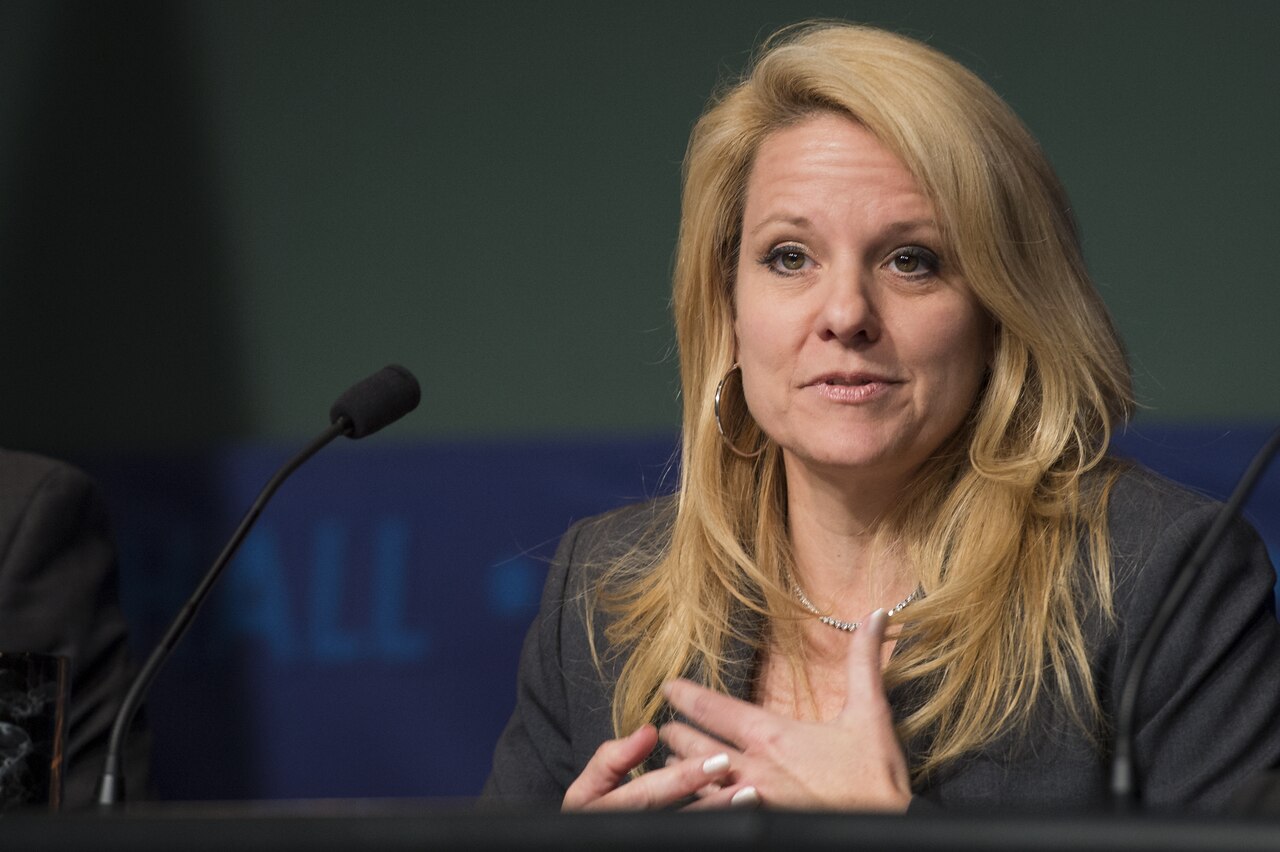
November 13, 2013: Shotwell speaks at a COTS panel at NASA Headquarters. This shows her later public-facing work, not her 2002 recruitment meeting. Photograph: NASA/Jay Westcott; NASA public-domain material. Source
The book does describe challenges to incumbents and procurement arrangements, including an objection to the noncompetitive Kistler award. Yet the military and NASA also provided crucial assistance: launch opportunities, access coordination, development funding and subsequent orders. An institution can contain both obstacles and people willing to support something new. Treating it only as an enemy can obscure possible allies; waiting passively for its approval can leave the door closed indefinitely.
So my note about standing firm needs a second half: identify the particular arrangement you want changed, and recognize who has a reason to help change it. Seeking fair access to competition and sustaining a working relationship do not always call for the same action.
Money buys another chance to learn
Money has tangible weight throughout this book. It means wages, transport, test stands, a replacement engine after a failure, and enough time to keep a team together for another attempt.
The fourth successful flight did not by itself secure the company's survival. In 2006, NASA entered an initial $278 million COTS development and demonstration agreement with SpaceX. At the end of 2008, it awarded a roughly $1.6 billion services contract covering twelve station-resupply flights. These arrangements had different purposes and performance structures; neither should be imagined as freely spendable cash arriving at once. Both helped connect technical progress with actual demand. NASA's milestone record and program review document these steps.
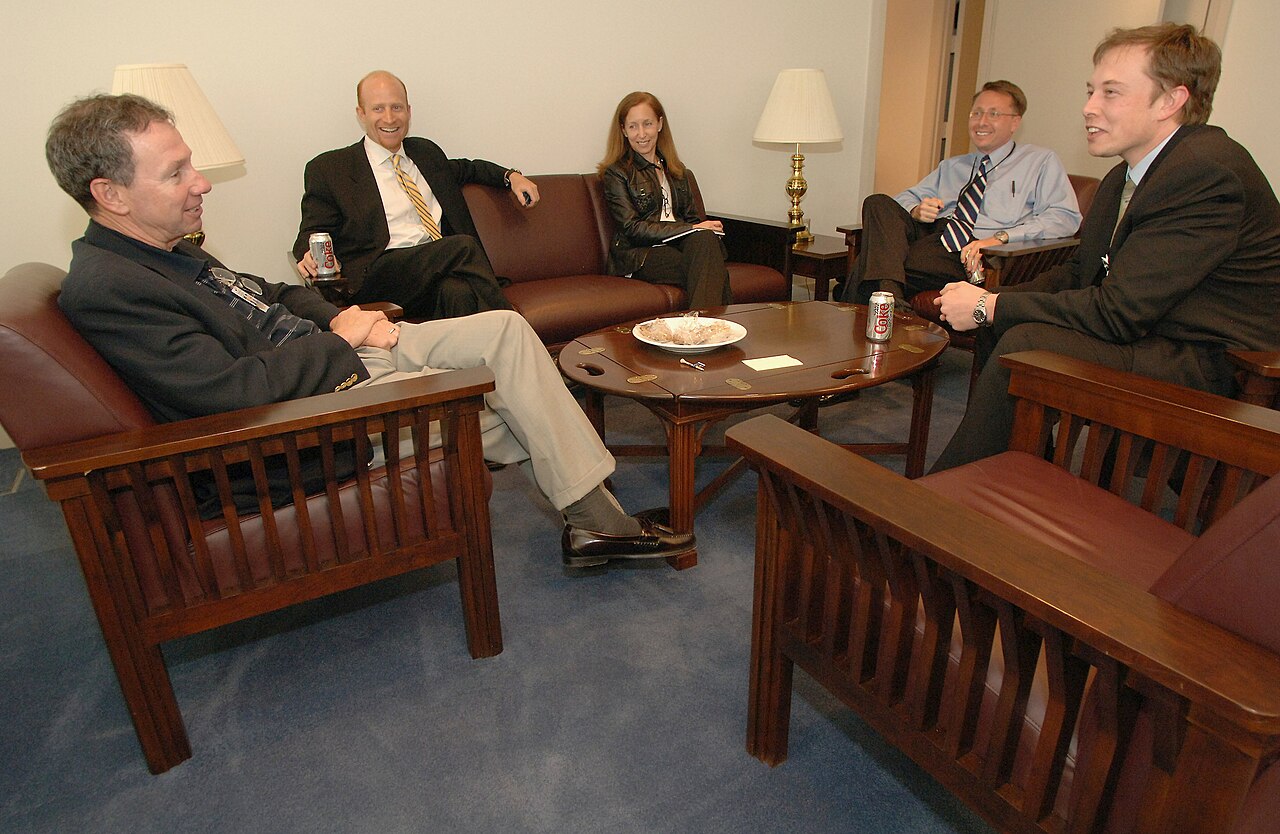
April 2005: NASA Administrator Michael Griffin (left) meets Musk (right) at NASA Headquarters. This is a meeting, not the signing of either the 2006 agreement or the 2008 contract discussed above. Photograph: NASA/Renee Bouchard; NASA public-domain material. Source

The importance of funding does not mean more funding solves every problem. A test that fails to reduce a critical uncertainty may exhaust its budget without improving the basis for the next decision. Conversely, an apparently expensive purchase that removes a project-wide wait may be better value than leaving the team idle.
My notes also ask whether money is the key lever in 3D-printed rockets. The epilogue mentions Relativity Space's ambition to accelerate development and lower costs this way. That was a technological and commercial aspiration at the time, not evidence that its promised benefits had already been delivered.
If I evaluate a similar approach, I want to identify the work it actually changes. Do fewer parts and assembly steps shorten whole-vehicle iteration? Do materials, inspection and rework consume the time saved? Once the factory moves faster, has the bottleneck shifted to testing, the launch site or a customer's mission? Those questions require data. An advanced-sounding process cannot answer them.
Moving at full speed therefore needs a specific object of scrutiny. Which action would help us discover soonest whether we are right? Spending there may expand our next set of choices, rather than merely keep the present direction running longer.
That is also why the eight weeks before the fourth flight felt so urgent: there was almost no room left to wait.
How a group of people caught a falling project
To make the fourth launch, the team used a C-17 to carry the first stage. As the aircraft descended, pressures inside and outside the rocket could not equalize quickly enough, and the tank began to buckle. The book recounts that transport calculations had been made, but their input parameters did not accurately cover the actual descent.
Altan went to the cockpit to coordinate a climb. Technicians searched for tools. Zach Dunn crawled into the interstage to open a pressurization line while his friend Mike Sheehan held his ankles. Each person had only enough time to address the most urgent piece within reach.
On the island, inspection revealed damage to internal baffles. Under the established process, disassembly, repair and testing were estimated to take six weeks, more than the company's finances could bear. Engineers and technicians worked in groups, removing the engine and plumbing and inspecting the structure, while quality staff struggled to keep records. In fewer than seven days, the first stage was assembled again.
It is difficult to read these passages unmoved. Yet the successful outcome cannot endorse every preceding risk. The emergency elicited remarkable cooperation while exposing gaps in parameters, transport preparation and safety margins. Rescuing a mission in extreme circumstances is different from being able to rely on those circumstances indefinitely.
I also remember what Hollman did before leaving. He sought a successor and taught the younger Dunn to understand the engine, monitor its data, and take over his position in the control room. Dunn recalled that assembling a Merlin engine from parts then took roughly a month. Capability passed between people as they found parts, assembled hardware, tested it and explained how it worked.
By the fourth flight, Hollman had left and watched remotely. He felt a complicated sense of loss while moving toward the family life he wanted. His work remained active in the team. Taking responsibility acquired another form: caring enough to hand the work to someone who could carry it after you left.
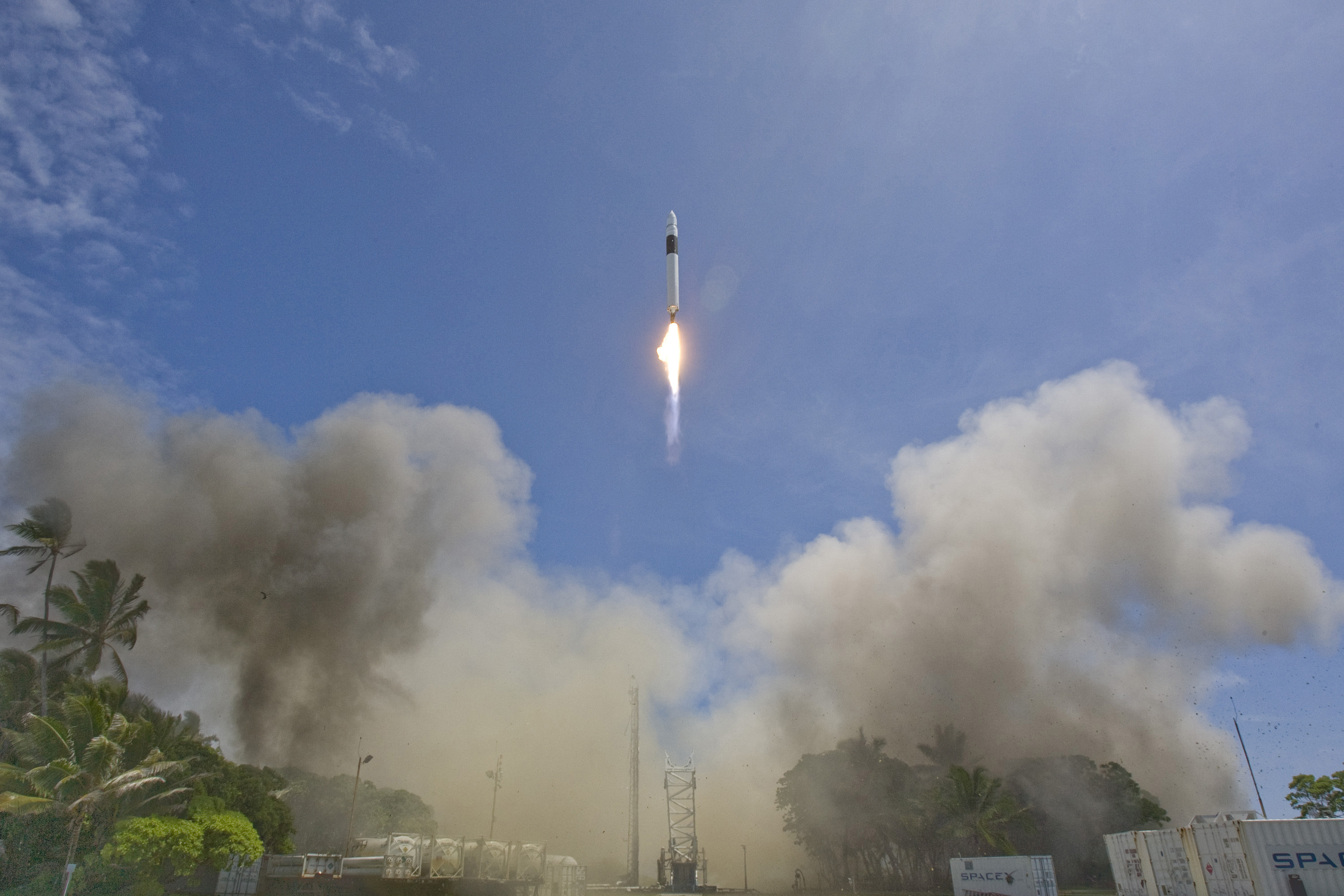
Falcon 1's fourth flight lifts off from Omelek Island in Kwajalein Atoll on September 28, 2008. Image: SpaceX, obtained through Wikimedia Commons, which identifies it as CC0 public-domain material. This photograph shows that launch, not the repair scenes described in the book.

On September 28, 2008, Falcon 1 finally reached orbit. My favorite celebration in the book is the exhausted team riding bicycles toward the dock, shouting “Orbit.” For that evening, the enormous ambition of space travel contracted into one concrete word. They had put something there with their own hands.
Perhaps that helps explain the commitment. Their judgments, manufactured parts and sleepless nights had entered a shared result. Not everyone could or wanted to remain in that life forever, and the costs differed for each person. But at that moment, many could recognize that they had genuinely taken part.
Back to my own next step
After reading, external conditions can still capture my attention. Insufficient funding, slow procedures and inaccessible resources may all be real; recognizing them belongs to sound judgment. I do not want to pretend they are absent merely to appear positive.
What I want to change is the habit of ending the explanation there.
If money is missing, I can ask what particular validation it would fund and whose decision the result could enable. If resources are missing, I can specify the equipment, interface document or decision-maker needed. If progress has stopped, I can return to the hardest question, examine the current basis for judgment, and decide what to test—or explicitly stop.
This way of speaking may help others judge whether to join. “The environment will not allow it” gives someone beside me little to act on. Explaining what is missing and what I am prepared to take responsibility for gives the work a place for shared participation.
None of this guarantees success. SpaceX benefited from money, talent, institutional opportunities and demand, as well as contingencies that cannot be reproduced. What I can bring back is a more ordinary demand on myself: when difficulty arises, let my participation leave a clear change.
Sometimes that means a timely decision or a more accurate test. Sometimes it means shielding a colleague from an unsupported accusation. Sometimes it means gathering everyone for a meal on the evening after failure.
I hope to become someone whose involvement gives a shared problem a little more possibility of moving forward.
Reading basis: Eric Berger, Liftoff (2021); Chinese edition Chong Xiang Huoxing, translated by Zhang Hanxiao, Huashan Literature and Art Publishing House, 2023. This essay draws mainly on chapters 1 and 3–10 and the epilogue. Most scene details come from participants' retrospective accounts and have not been individually checked against original records. The orbital-flight date was separately compared with the FAA's Fourth Quarter 2008 Commercial Space Transportation Report; NASA program amounts and categories are linked in the text. Technical and organizational interpretations are my reading judgments. Questions about assessment and certainty, and money as a key lever, develop the original notes. This essay was assembled on November 16, 2026; the notes label February 9 and 10 without a year, so those labels do not establish an original reading date.