IN PASSING

Catch a thought.
Leave a trail.

Thoughts still forming, moments from reading and everyday life.
No rush toward a conclusion. A footnote for this moment is enough.

233MOMENTS & THOUGHTS
A RUNNING RECORDOriginal publication date · New → Old

2026 / FIELD ENTRIES

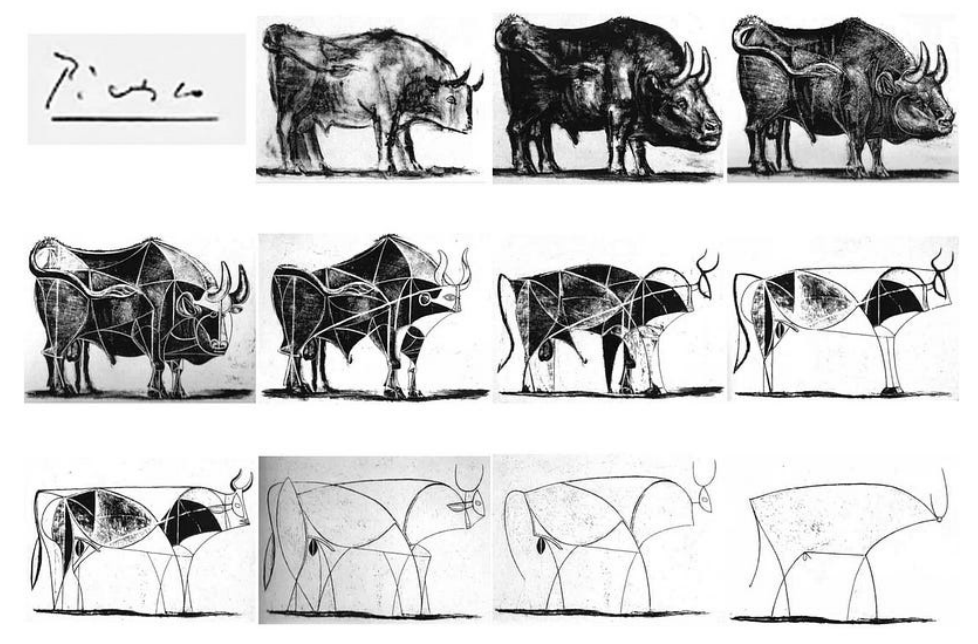
Picasso made eleven versions of a bull. The first was realistic, every hair in place. The last had only a few lines, yet looked more like a bull than the first.

He said that a painting used to be the result of adding things; for him, it became a process of taking things away.

You think essence is built by piling things on. In fact, it is what remains when nothing more can be removed.

That thing you are working on—a self-introduction, a product, an essay—are you still adding to it, or do you dare to subtract?

Reflection inspired by Tiago Forte's article on progressively summarizing multimedia content.
Entry image 1, 2026-06-13

Your latest carefully considered decision—headphones, a coat, a desk, a workout plan—did you really choose from endless possibilities, or pick the safest middle option among Wirecutter's five recommendations?

You think you are choosing individuality, but the available range has already constrained you.

Perell cites Simon Sarris: as chains like Home Depot and Lowe's spread, each now with more than 2,000 stores, home hardware becomes increasingly commoditized. Everyone's doorknobs look similar. Consolidated manufacturers and distributors carry only a few brands, and details in our homes begin to converge.

Before you choose, the range of choices has limited you. IKEA offers 31 options for a 6-by-8-foot high-pile rug. That sounds like a lot, but its $45 billion in annual revenue means thousands of people buy the same rug that supposedly expresses your individuality. We try to be different and end up alike.

A friend's reflection suggested an interesting perspective. Let me extend it through information theory, over the same span of time.

Printing in the physical world uses the medium of human communication—language—to transfer information from biological storage with a high rate of entropy increase, the brain, to more stable physical storage such as paper. It preserves and transmits data efficiently, slowing the rate at which the total information of a civilization degrades.

Coding agents in the software world use the medium of Turing-machine communication—code—to move information processing from biological computation with limited capacity, the brain, to scalable physical computation such as silicon. They process data and produce outputs efficiently, increasing the total information civilization can derive from existing data.

If the goal were to maximize civilization's total information, what would the next important problem be? Once we have extracted all the information latent in existing data, through AGI or other means, what bottleneck prevents further growth?

Entry image 1, 2026-06-02

Everyone follows a very different path toward their own global optimum.

Still, there is something to learn from the logic of key decisions and of avoiding local optima.

An individual choosing to board the ship at the very crest of the era's wave.

It recalls a saying in Guiguzi: those who perceive momentum are discerning; those who follow it are wise; those who command it stand apart.

Karpathy is a first-rate observer of momentum, and has the courage to step in and steer it. Respect.

An idea that really matters will appear more than once.
A practice that really matters will not be accomplished in one attempt.

Day 1 questions from Investing in Outliers: momentum.

If I place Harnetics on the map of China's commercial space sector, what genuinely rising momentum is it borrowing, rather than a wave I have imagined?

A line from the book: without momentum, we will achieve nothing.

Check these when answering:

  • Does that momentum come from national strategy, confidentiality procedures, pressure from program documentation, commercial space financing, or the wave of AI tools?
  • What evidence shows it is not a transplanted SpaceX narrative or Silicon Valley productivity narrative?
  • If Harnetics could choose only one source of momentum, which real situation should it move closer to this week?
Entry image 1, 2026-05-04

Doing things is like playing the piano. What matters is rhythm, not speed: the rise and fall of your feelings, how you shape each phrase, your grasp of the whole movement. A score gives you clefs, key signatures, rhythm markings and technique markings. In life you have something more valuable: question marks.

Working hard is linear. Giving it everything is nonlinear.
Be ambitious in strategy and even-tempered in tactics.

Why use AI to reduce the alignment tax in space companies?

April 12: International Day of Human Space Flight.

Sixty-five years after Gagarin's first flight, the biggest friction in getting a rocket into the sky is not propellant ratios—it is document alignment.

In key decisions, going all-in is often a difference between zero and one, rather than a difference in acceleration.

The purpose of all systems engineering activities is to manage risk.
—INCOSE Systems Engineering Handbook

It only depends on what you are willing to operate as a system.

Bottom-up is the possibility of emerging, networked causality.
Top-down is the certainty of internally consistent, linear causality.

End well to begin well. What matters is completion.
Whatever the outcome, keep a sense of reverence.

Experience: three parts genetic recipe, two parts fermented through childhood and growth.
Three parts hardware state: the body's internal environment and its physical and social surroundings.
Two parts software state: the algorithm interpreting the world and the data currently being processed.

Empathy among carbon-based beings draws its depth from the first eight parts.
Silicon excels at the breadth of its input data and the computational depth of processing.
For a carbon-based truth-seeker, a silicon companion is isomorphic to a mathematical system.

So for carbon-based truth-seekers, being data-driven offers greater acceleration than being computation-driven.

Entry image 1, 2026-03-08