
First learn to live with yourself; then with the world.
IN PASSING
Catch a thought.
Leave a trail.
Thoughts still forming, moments from reading and everyday life.
No rush toward a conclusion. A footnote for this moment is enough.
233MOMENTS & THOUGHTS
A RUNNING RECORDOriginal publication date · New → Old
2025 / FIELD ENTRIES
Good things unfold layer by layer.

Playback unavailable. Listen on NetEase instead.
Listen on NetEaseFlowing water does not envy trees. Precisely because it has no roots, it can pass through gullies and small things, touch hardness and softness, brush past warmth and indifference. It needs neither destination nor direction, only to keep company with time and with itself.
A pure pioneer.
Both admirable and inspiring.

Mindset: mental energy, honesty, patience, willingness to look foolish, a growth mindset.
Practice: first-hand data, making intuition concrete, getting close to the simplest details.
—How To Understand Things

Perception may be the user interface through which life's hardware accesses its environment.
The buttons and cursor on that interface may not be what matters.
What does matter is an interesting question.

A life is a collection of perceived data.
The data you shut out forms your outline.
Sincerity defines what is worth modeling in the pursuit of truth.
Truth revises what is worth pursuing with sincerity.
The driving logic of a goal-directed agent may be a cycle of two parts:
From inside out, seeking consistency in a closed system: reward maximization, sincerity.
From outside in, modeling an open system: error minimization, truth.
At the beginning of the year, @Li Jigang shared an insight about sincerity and truth.
It was like planting a seed that took root today. Grateful for the encounter.

Choosing the right level of abstraction aligns with the recipient's level of information.
Reducing a team's narrative debt lowers the sender's information entropy.
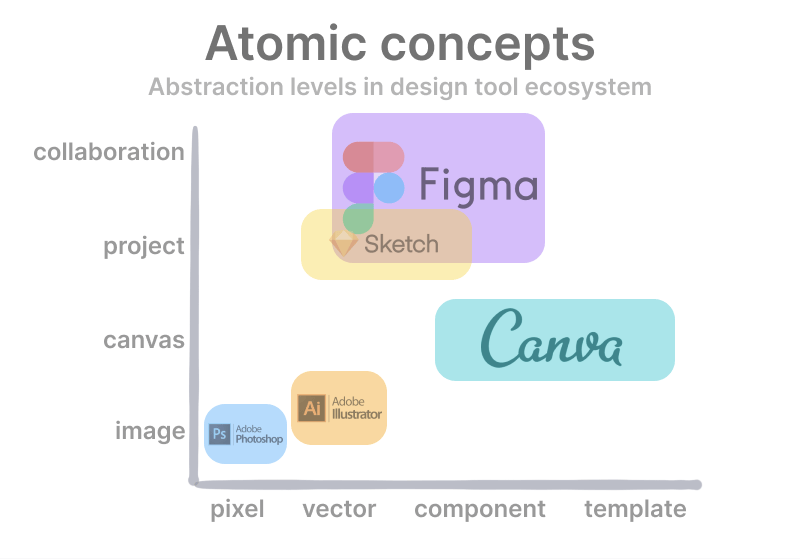
Different levels of a complex system have different causalities.
To define a problem, first specify the system level.
A microscopic event may be mere noise at the macroscopic level.
Accuracy of understanding ≈ precision of prediction.
Practice is the process of revising predictions through feedback.
Building makes practice possible from zero to one.
So building is also a process of understanding.
@42 shared the logic of improving one's own system in a small group. It reminded me of the system properties in Thinking in Systems, which 42 recommended.
Process data progressively through a weekly cycle with three levels.
Execution days: focus on running the current system in the real world.
- Collect bug data encountered in execution.
- Archive real-world data from operating the system.
Process days: analyze and distill the data collected on execution days.
- Bug data + resilience = revising and improving old programs.
- Real-world data + self-organization = abstracting and generating new programs.
Cognition days: review the usability of the improved and generated programs.
- Logical rigor = appearances + nonlinearity + bounded rationality.
- Operational compatibility = delays + boundaries + limiting factors.
Your system has its own goals; it does not need another system's approval. What matters is whether it reaches your goals more precisely and efficiently in the real world.
A clear, well-layered three-level structure. I learned a lot.

The point of delayed gratification is not delaying short-term positive feedback,
but not letting that feedback drive your behavior.
Find a slope along which your state of mind can rise smoothly.
What should a good outlier-finding process include? 1. Try more. More samples mean a greater chance of finding an outlier. 2. Clarify the goal: understand what the best possible result might look like, so you know when to stop. 3. Find an e…
What should a good outlier-finding process include?
- Try more. More samples mean a greater chance of finding an outlier.
- Clarify the goal: understand what the best possible result might look like, so you know when to stop.
- Find an evaluation method closely tied to the core need: select what could be extraordinary, rather than what is probably decent.
- Sample and evaluate as quickly as possible, so you can iterate the sampling strategy.
- Do not lose heart after repeated failed attempts.
—Ben
Qualitative goals → quantitative evaluation → strategy iteration → sustained sampling.
The qualitative goal identifies which sample fields are worth evaluating quantitatively.
Quantitative evaluation defines what counts as an outlier.
Strategy iteration ensures efficient collection of those fields.
Sustained sampling ensures sufficient time spent collecting them.
This aligns with the curiosity strategies for AI I have been studying. Curiosity without a qualitative goal pores over environmental noise all day. Curiosity without quantitative evaluation can become overwhelmed by complexity.
It recalls the novelty-search algorithm in Why Greatness Cannot Be Planned: seeking novelty is seeking complexity, and greater complexity is often more effective.
An interesting question: how do we define the fields and criteria of curiosity?
Wittgenstein's arguments are interesting, but not a priori. For example, the claim that language must be discussed in an already existing language produces an infinite regress: where did the first language come from? For alignment, how do…
Wittgenstein's arguments are interesting, but not a priori. For example, the claim that language must be discussed in an already existing language produces an infinite regress: where did the first language come from?
For alignment, how do we define objective and subjective? The existence of a subjective subject is itself an objectively existing physical implementation. Could individual influence then be objectively quantified in some symbolic system?
Linguistic descriptions use symbols suited to the limited computation of individual humans, mainly for communication. Beyond their historical baggage, those symbols are conventional. A model based on human language may merely be aligning with the collective human record.
That brings us to a concrete, useful question: can an LLM have taste? Is the taste you define a subset of the collective human record? If not, how would the data be collected, encoded and made amenable to backpropagation? If so, how do you evaluate taste, and establish the reliability and validity of that evaluation?
The symbolic system a model uses may set alignment's ceiling. Parameter count determines the size of latent space: the dimensions of the library building. Semantic space depends on the symbols and the information represented: the knowledge system built by the books. People of the north do not dream of elephants. Alignment requires that the relevant information exist in that knowledge system.
What symbolic systems and content could allow an AI to grow an internally consistent logic of its own?

An interesting question. I think it depends on the purpose. Take beauty: if the aim is to give an LLM average human aesthetic ability, perhaps it is an alignment problem once we define what counts as beautiful.
Thinking in reverse raises another question. A human brain pretrained on human symbols is already aligned with many definitions. Biases across cultures may simply be definitions from different viewpoints. Could those biases affect the ability to ask good questions?
An AI-native symbolic system is an interesting problem.
This is inspiring: taste or intuition may not be so mysterious; it may result from context compression. But human language cannot cover every situation. Much cannot be expressed in words—beauty, for example, or Sartre's prereflective cogito. How can we compress what lies beyond what context can express?
—@lumen951

Asking good questions does not mean ignorance.
Knowing what you do not know is the third stage:
being honest and clear about the boundary of your knowledge.
Neither problem setters nor problem solvers are superior.
But one comes before the other, so
the problem setter often sets the ceiling of the solution.
AI is already a good enough problem solver.
I believe it can become an even better problem setter.
Cross-disciplinary work is only one aspect. What matters is
that I can see the boundaries in its view.
An insecure person proves themselves.
A person at peace with themselves is honest about who they are.
When faced with a problem, besides solving it,
a different perspective may even let you use it.
The key is whether you take defining the problem seriously.
Pressure is a good thing.
It is the outside force that pushes you out of your comfort zone.
Whether building a startup or just working out,
it points toward progress.
It can be encountered, but not demanded.