
001|Space Weekly|In-Orbit AI Begins Learning as Extreme-Environment Validation Advances
In-Orbit Learning and Engineering Validation in Extreme Environments
October 13–19, 2026, Beijing Time · Published: October 20, 2026
This issue selects 12 developments from public papers, mission logs, and institutional technical releases to examine how space systems are gaining greater autonomy, environmental adaptability, and the ability to operate continuously. In-orbit training, low-temperature batteries, and full-spacecraft environmental testing are the three main focuses. Understanding these results requires looking at both performance figures and validation conditions: whether the trained model was connected to control, whether the cells still need heating, and which flight risks the ground tests covered.
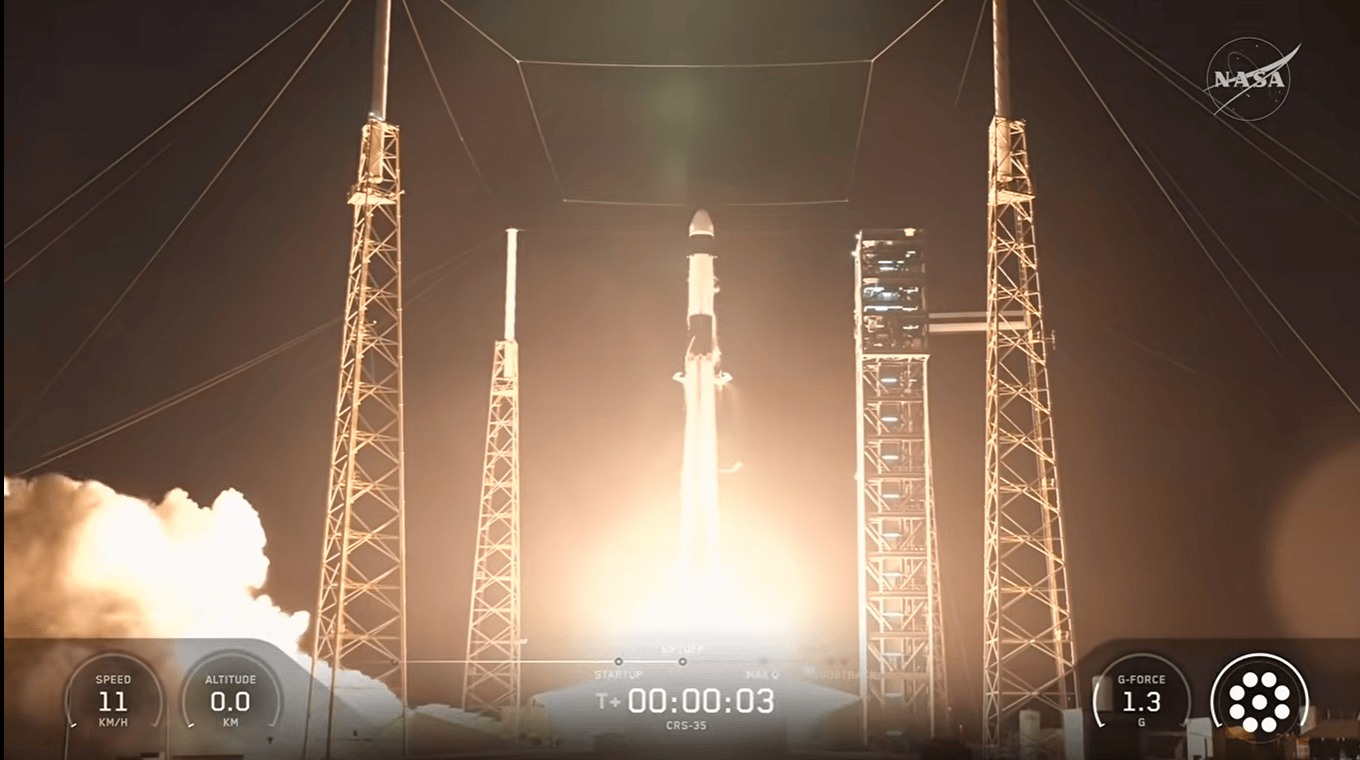
The SpaceX CRS-35 resupply mission launched on October 13. This issue also follows its subsequent docking and the research payloads it carried. Image source: NASA, image accompanying the original news release.
This Issue at a Glance
- This Week's Focus: CubeSat in-orbit training and control, low-temperature solid-state batteries, and lunar lander environmental testing.
- Research and Engineering: Mars rover autonomous navigation, methane engine subsystems, meteorological remote sensing, rice in space, event-based vision, and Phobos sample return.
- Missions and Industry: An upgraded Zhuque-2 launch, space station resupply, and a revised timetable for Neutron's first flight.
Reporting Scope: The reporting window runs from 00:00 on October 13 to 24:00 on October 19, 2026, Beijing Time. Event dates and publication dates are labeled separately; results that occurred before the window but were made public this week are marked as disclosed this week. Mission plans are described as they stood at the end of the window.
This Week's Focus
01|6U CubeSat Completes In-Orbit Training and Connects a Vision Model to Attitude Control
Field: AI and autonomous systems
Validation Stage: In-orbit technology demonstration; preprint
Publication Time: October 14, 03:57 Beijing Time
Event Time: 12 experiments conducted over approximately the preceding year; paper made public this week
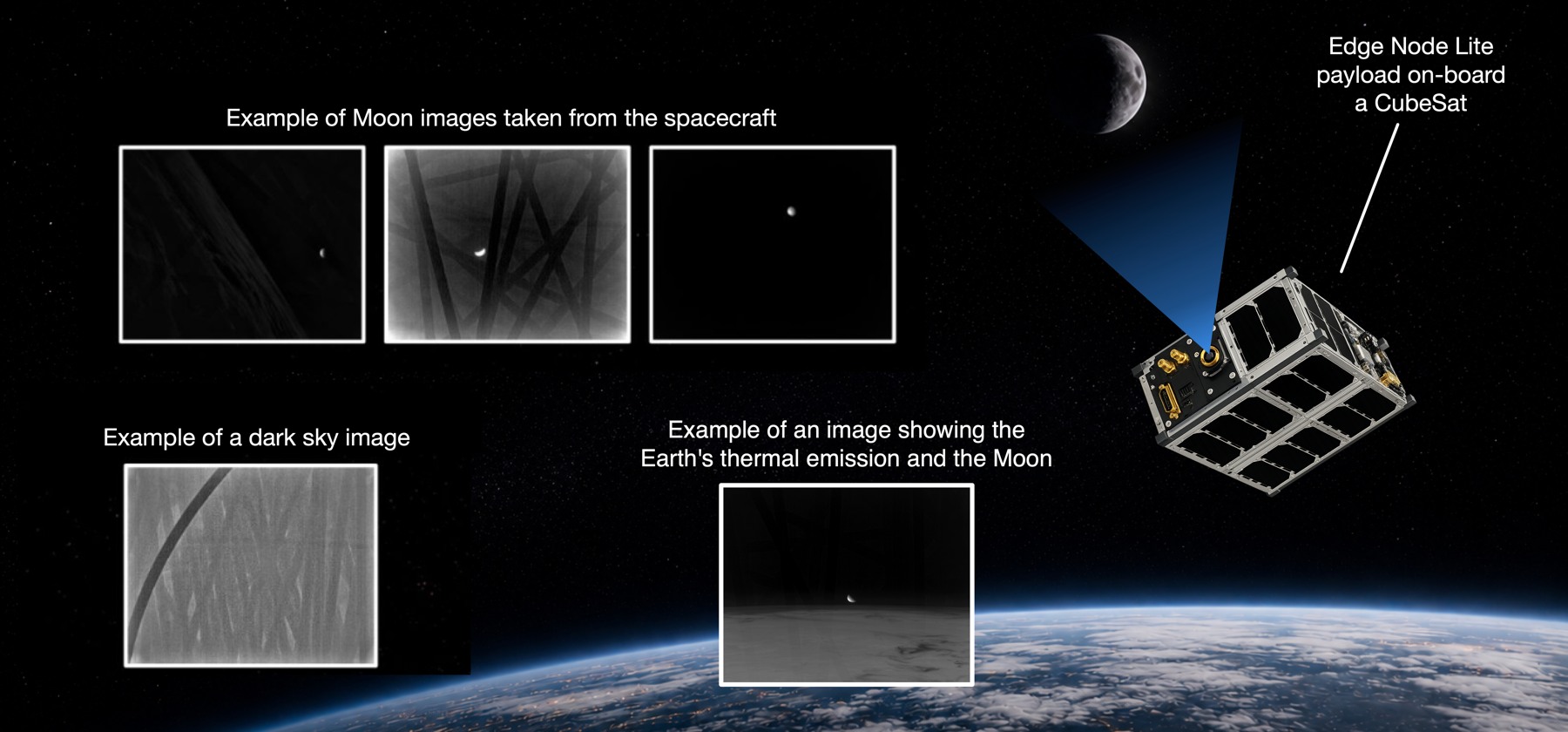
Figure 1 of the paper places a diagram of the 6U satellite alongside thermal images acquired in orbit. The satellite diagram is at the upper right; the other panels include the Moon, Earth, and dark backgrounds. Source: Lupu et al., 2026, CC BY 4.0.
The latency and bandwidth constraints of deep-space communications make it necessary for spacecraft to perceive and act locally. A team from the California Institute of Technology and The Aerospace Corporation published a set of 6U CubeSat experiments: training a thermal-infrared segmentation model in orbit on an NVIDIA Jetson TX2 NX, then feeding the segmentation results from lunar images into the attitude control loop.
The team conducted 12 experiments over approximately one year. One training run reported in the paper consisted of two stages totaling 60 epochs, took about 13 minutes, and achieved a final mean intersection over union, mIoU, above 0.9. The model then estimated the Moon's position from a live image stream and, together with filtering and attitude commands, drove the satellite to track the target. Early tracking exhibited oscillations, which improved after adjustments to the frame rate, buffering, and control parameters.
The work also exposed integration difficulties: during ground testing, transient current from the training workload had caused a power loss, and the team changed the Jetson power mode from 20 watts to 15 watts. Training labels were generated on the ground and uploaded, and the experiments also used multiple layers of protection. These results therefore do not establish a general capacity for autonomous learning without ground supervision. The paper is a preprint.
Observations and Analysis
What merits continued attention is the joint validation of learning algorithms with power, thermal control, data transmission, and control stability. The next question is whether reliability can be maintained with more complex targets, out-of-distribution inputs, and longer operating periods.
See original source [01] at the end.
02|Solid-State Battery Prototype Operates at Minus 80 Degrees Celsius in Thermal Vacuum
Field: Energy and environmental adaptability
Validation Stage: Ground testing of prototype cells
Publication Time: October 14, 22:41 Beijing Time
Event Time: Recent tests; disclosed this week
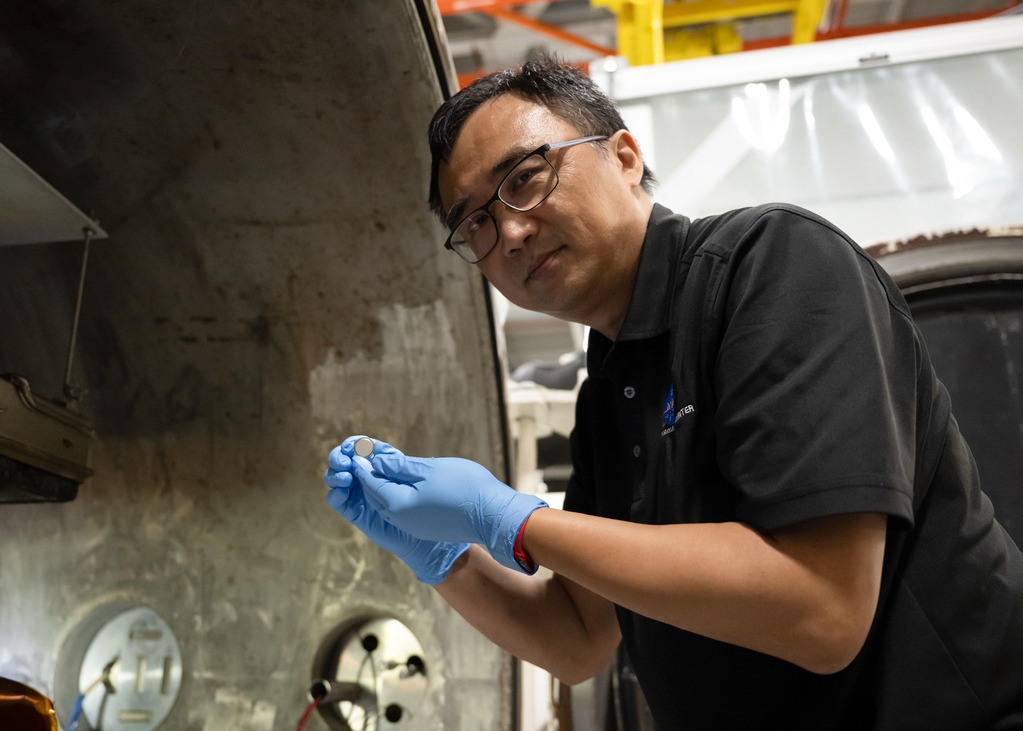
NASA researcher Yi Lin displays coin cells that have undergone thermal-vacuum testing. The photograph shows small prototypes, rather than a battery pack already deployed on the lunar surface. Photo: NASA/Ryan Hill.
Batteries for equipment in the lunar polar regions must both supply power and withstand prolonged cold. On October 14, NASA introduced its SPEARS solid-state battery project: replacing liquid electrolytes with solid electrolytes to explore ways of reducing the burden that extreme environments place on batteries and thermal insulation systems.
In thermal-vacuum tests at Langley, small prototype cells performed well between minus 60 degrees Celsius and 80 degrees Celsius and remained operational at minus 80 degrees Celsius, though with reduced performance. The cells suffered no damage after exposure to extreme temperatures ranging from minus 170 degrees Celsius to 100 degrees Celsius.
Operating temperature and survival temperature are two different measures. The cells cannot deliver power at minus 170 degrees Celsius and still require heating to resume operation. The public report also did not provide cycle life, specific energy, or battery-pack-level data suitable for system comparisons; flight hardware and space testing are still being prepared.
Observations and Analysis
If the ability to resume operation after a cold soak is further validated, some equipment may be able to reduce its need for continuous heating. Whether this saves total mass and energy still requires accounting for heaters, packaging, controls, and mission cycles together.
See original source [02] at the end.
03|Griffin One Lunar Lander Completes Multiple Full-Spacecraft Environmental Tests
Field: Lunar transportation and testing
Validation Stage: Ground environmental testing of the complete spacecraft
Publication Time: October 13, U.S. Eastern Time
Event Time: Testing began in July; completion status disclosed this week
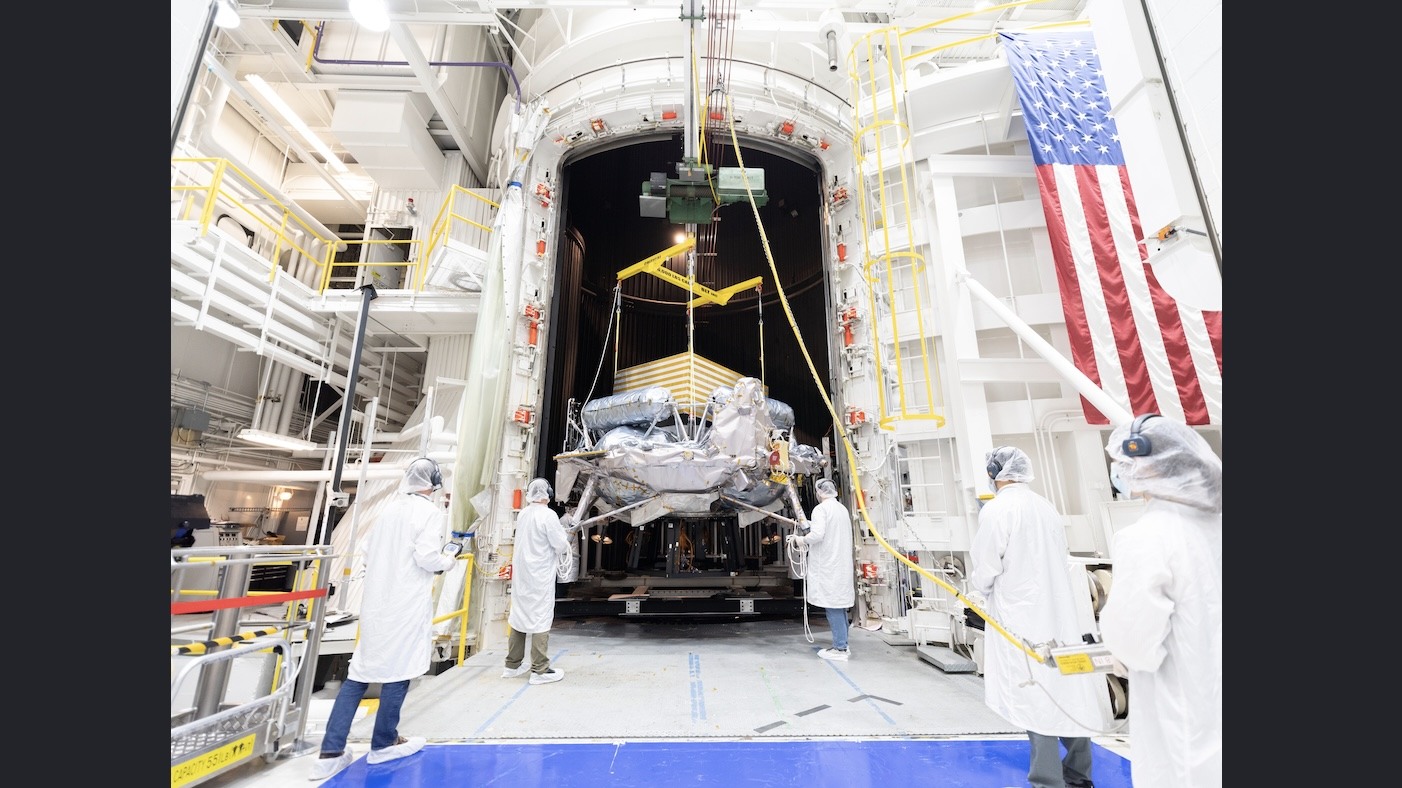
Griffin One was moved into JPL's 25-foot Space Simulator on August 31. The image records preparations for testing; the public report was released this week. Source: NASA/JPL-Caltech.
The reliability of commercial lunar transportation needs to be validated at the full-spacecraft level. NASA disclosed on October 13 that Voyager Technologies' Griffin One lander had completed a series of environmental tests at the Jet Propulsion Laboratory, covering mass properties, electromagnetic compatibility, vibration, acoustics, and thermal vacuum.
Acoustic testing applied an environment of up to 153 decibels. Approximately two weeks of thermal-vacuum testing alternated between simulated conditions as high as 75 degrees Celsius and as low as minus 100 degrees Celsius. The different tests examined the effects on the complete spacecraft of mass distribution, interference among electronic devices, launch loads, and the temperature environment in space.
The lander subsequently returned to its manufacturing facility for final assembly; launch and delivery to the lunar surface remain to be completed. Passing environmental tests increases confidence in the conditions tested, but does not directly mean that powered descent, soft landing, and lunar surface operations have been validated.
Observations and Analysis
For teams interested in testing and engineering tools, this development suggests a specific point to watch: how to establish traceable links among environmental test results, anomaly handling, and mission requirements while reducing repeated validation later.
See original source [03] at the end.
Research and Engineering Developments
04|Perseverance Passes 45 Kilometers of Driving, Setting an Off-World Vehicle Record
Field: Planetary exploration and autonomous navigation
Validation Stage: Sustained operation on the Martian surface
Publication Time: October 13, 05:20 Beijing Time
Event Time: Record set on October 11; disclosed this week
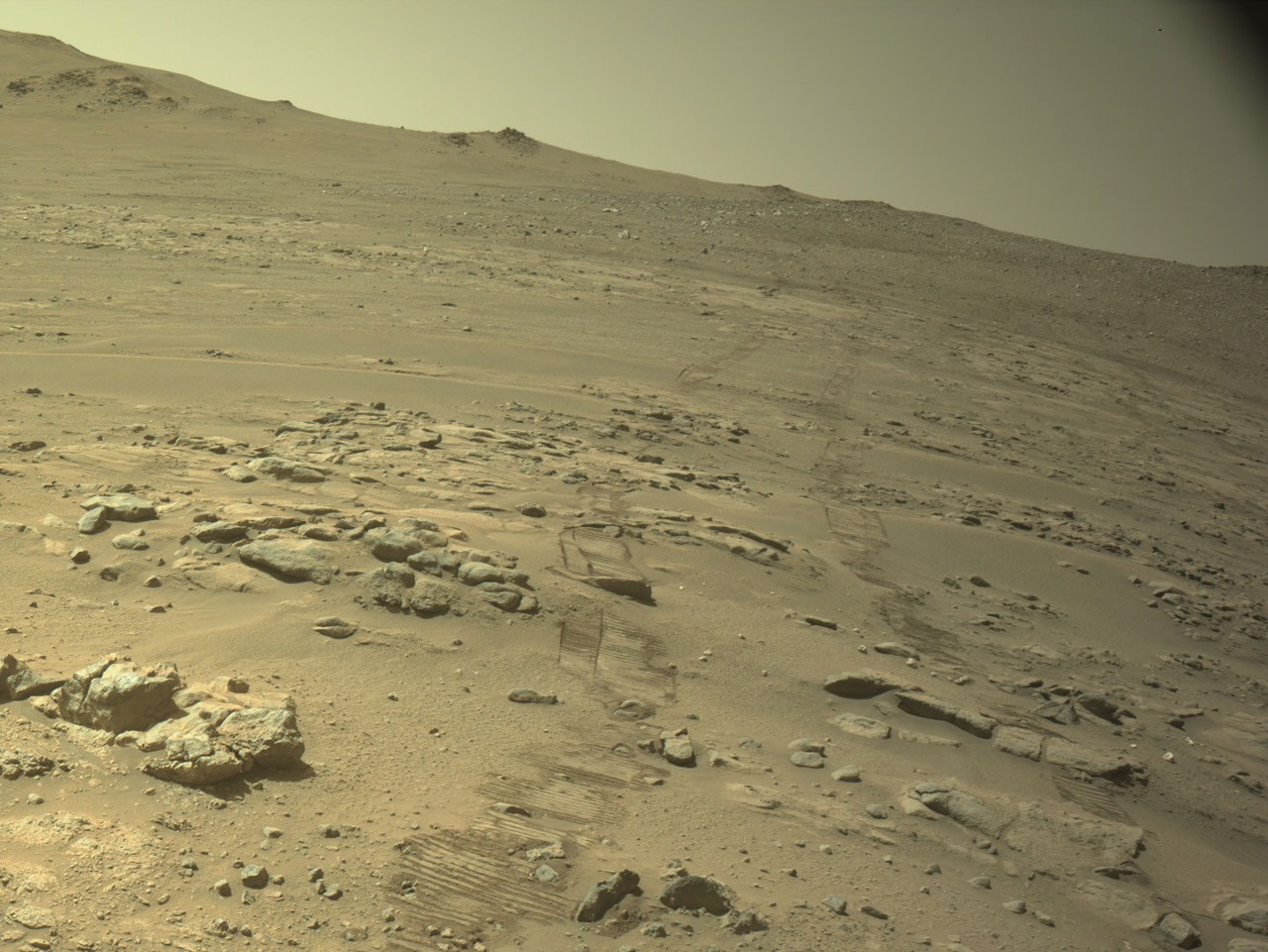
The Martian surface imaged by Perseverance's navigation camera on October 11. A 91.31-meter drive that day took its cumulative distance beyond the previous record. Source: NASA/JPL-Caltech.
NASA's mission team reported that Perseverance brought its cumulative driving distance to 45.22 kilometers on its 2006th Martian day, surpassing Opportunity's 45.16 kilometers. The drive that day covered 91.31 meters, and more than 90% of the cumulative distance used AutoNav autonomous navigation.
The distance record reflects the combined capabilities of the vehicle, navigation, and mission operations. Greater reach can expand the scope of scientific investigation, but cumulative distance alone does not demonstrate the value of scientific discoveries. Further attention should go to autonomous navigation efficiency in complex terrain, wheel condition, and time available for science.
Observations and Analysis
Sustained operational data can test the practical contribution of autonomous systems; evaluation still needs to consider driving speed, planning costs, fault recovery, and scientific output together.
See original source [04] at the end.
05|ISRO Discloses Progress on Subsystems for a 1100-Kilonewton Methane Engine
Field: Propulsion and additive manufacturing
Validation Stage: Subsystem testing and qualification
Publication Time: October 16
Event Time: Full-scale gas generator first fired on October 9; disclosed this week
ISRO stated that the full-scale gas generator for its 1100-kilonewton-class LME1100 liquid oxygen–methane engine completed its first firing on October 9. The engine uses a gas-generator cycle, with more than 70% of its components produced through additive manufacturing; the turbopumps, thrust chamber, igniters, and other components are at different stages of testing.
The article tested in this firing was the gas generator, so it cannot be described as a successful test of the complete 1100-kilonewton engine. The complete engine is planned to be ready in mid-2027 and to undergo qualification hot-fire tests. The agency also disclosed that design work on a 2400-kilonewton full-flow staged-combustion engine had been completed, which does not establish that hardware validation is complete.
Observations and Analysis
The engineering value of additive manufacturing still requires validation of consistency, defect detection, service life, and repairability. The proportion of components manufactured this way cannot be directly converted into a reduction in engine cost or development time.
See original source [05] at the end.
06|Fengyun-4 Microwave Satellite Sounder Completes Atmospheric and Lunar Field Observations
Field: Remote-sensing payloads and calibration
Validation Stage: Ground field testing of a payload
Publication Time: October 16
Event Time: Completed recently; specific date not disclosed
Institute 804 of the Eighth Academy of China Aerospace Science and Technology Corporation completed field tests of the millimeter-wave and submillimeter-wave sounder for the Fengyun-4 microwave satellite, observing both the atmosphere and the Moon. The team used a metal-hopper atmospheric observation shielding system to test full-aperture, end-to-end detection capabilities and used a complete map of lunar microwave brightness temperatures to calculate the accuracy of beam-pointing registration between channels.
Such tests examine the detector, optical or antenna systems, and signal-processing chain together. What has been made public is progress in ground validation. The original report did not give specific figures for registration accuracy, resolution, or similar measures, and it does not mean the satellite has completed in-orbit validation.
Observations and Analysis
Accurate alignment among observations from multiple channels is an important step in turning hardware output into comparable scientific data. Subsequent milestones to follow include integrated satellite testing, in-orbit calibration, and the final data products.
See original source [06] at the end.
07|China's Space Station Completes Sample Collection and Sowing for a New Rice Experiment Batch
Field: Space life sciences
Validation Stage: In-orbit cultivation and sample collection
Publication Time: October 18, 11:00
Event Time: Recent in-orbit operations; released this week
Tiangong TV, released by the China Manned Space Agency, showed the crew completing sample collection, sowing, and storage for a new batch of space rice experiments, with related cultivation work continuing. The public report used the wording that it is hoped to achieve the first in-orbit cultivation of two generations of rice, indicating that this objective still requires confirmation through the subsequent process.
The research significance of this development lies in tracking plant performance through successive cultivation in space. Completing sample operations is not enough to demonstrate long-term genetic stability, and still less does it mean the space station has achieved crop self-sufficiency; that also involves yield, nutrition, resource consumption, and system cycles.
Observations and Analysis
Sustainable life support requires translating biological findings into quantifiable system metrics. The next round of observation should focus on the complete cultivation results and subsequent sample analysis.
See original source [07] at the end.
08|Event-Based Vision Method Reduces Errors on a Spacecraft Pose-Tracking Benchmark
Field: Perception and in-orbit operations
Validation Stage: Ground dataset evaluation; preprint
Publication Time: October 14, 10:46 Beijing Time
Event Time: Preprint made public this week
Zhang et al. proposed the OA-EI method, which maintains spacecraft pose estimates through kinematic prediction and then selectively corrects them using event-based visual information. The study evaluated four physical-event trajectories from FRESH, including 20 rollout starting points and three training random seeds.
At the 7.7-second evaluation point, compared with the prediction-only baseline, rotational error fell from 41.63 degrees to 15.73 degrees, and translational error from 57.28 millimeters to 22.41 millimeters. On a Jetson Orin Nano, the median time for a single in-memory update was 44.56 milliseconds. These results are limited to the paper's settings and do not include end-to-end validation of an actual in-orbit rendezvous; the update time also cannot be treated as complete system latency.
Observations and Analysis
The approach uses a model to provide continuous predictions and sparse observations for correction. Engineering usability also depends on robustness to initialization, changes in the target, lighting, and sensor noise.
See original source [08] at the end.
09|MMX Announces Launch Arrangements for Its Phobos Sample-Return Mission
Field: Deep-space mission outlook
Validation Stage: Mission plan; not yet launched at the reporting cutoff
Publication Time: October 13
Event Time: Launch planned for October 20, 03:41 Beijing Time
On October 13, ESA introduced the Japanese-led MMX mission to explore the moons of Mars. The announcement listed the launch time as October 20 at 04:41 Japan Time, or 03:41 Beijing Time, after this issue's reporting window. The mission aims to investigate Phobos and Deimos and return samples from Phobos to Earth.
The planned Idefix rover has a mass of 25 kilograms and will investigate the surface of Phobos and provide information for the main spacecraft's landing. The public timetable anticipates arrival at Mars in 2027, sampling in 2030, and the return of at least 10 grams of samples in 2031. These are all plans, and each should be updated subsequently according to actual launch, cruise, and sampling status.
Observations and Analysis
Contact, movement, and sampling on the low-gravity surface of a small body are the engineering aspects of this mission to watch. Returned samples can be analyzed repeatedly with large instruments on the ground, extending the mission's scientific value.
See original source [09] at the end.
Mission and Industry Briefs
10|Upgraded Zhuque-2 Y4 Launches Ten Satellites on a Single Rocket
Field: Commercial launch
Validation Stage: Orbital launch completed
Publication Time: October 14
Event Time: October 14, 19:40 Beijing Time
The China National Space Administration announced that the upgraded Zhuque-2 Y4 lifted off from the Dongfeng Commercial Aerospace Innovation Test Zone and delivered 10 satellites into their designated orbits. This was the 10th flight of the Zhuque-2 series. The announcement did not disclose total payload mass, orbital insertion accuracy, or cost, so it does not yet allow improvements in launch capacity or economics to be quantified.
See original source [10] at the end.
11|CRS35 Docks, Delivering the Space Station's Final Set of Roll-Out Solar Arrays
Field: Space infrastructure
Validation Stage: Transport and docking completed; installation pending
Publication Time: October 15, U.S. Eastern Time
Event Time: Docking on October 15, 22:27 Beijing Time
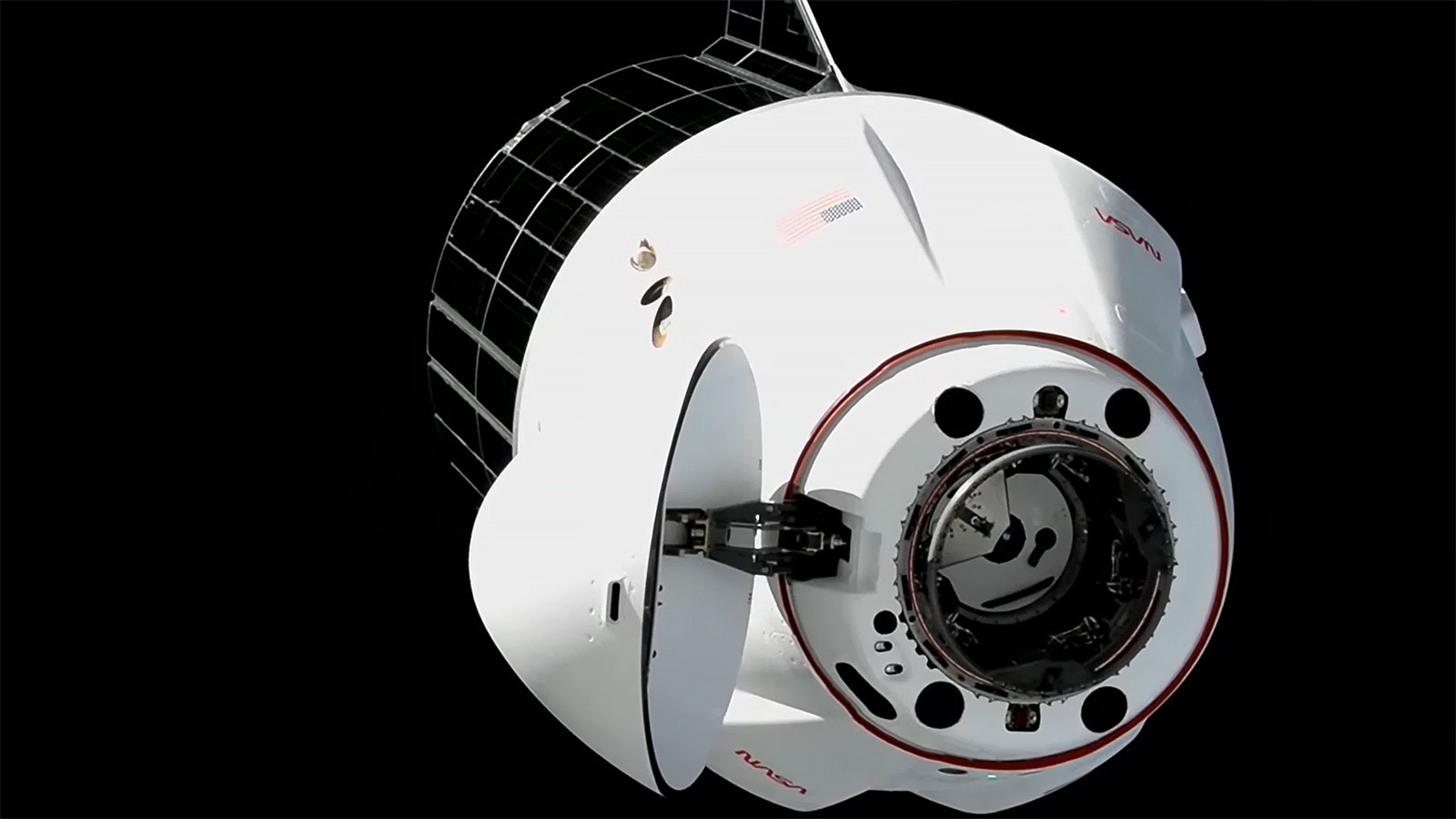
The cargo Dragon spacecraft approaches the International Space Station before docking on October 15. Source: NASA+.
SpaceX's 35th NASA commercial resupply mission delivered more than 6300 pounds of supplies to the space station, including the final set of iROSA roll-out solar arrays and experimental payloads for artificial retina manufacturing, three-dimensional cardiac tissue models, and other research. Solar array installation and the research experiments still need to be carried out; delivery of the payloads alone does not mean the associated medical or manufacturing results have been achieved.
See original source [11] at the end.
12|Rocket Lab Revises Neutron First-Flight Expectation to 2027
Field: Development progress
Validation Stage: Development timetable revised
Publication Time: October 15, 04:40 Beijing Time
Event Time: Announcement this week
Rocket Lab released an update on October 14, U.S. local time, revising its expectation for Neutron's first launch to 2027. The short official announcement did not elaborate on the technical reasons, so this issue does not attribute the change to any particular component or manufacturing problem. Further attention should go to verifiable test completions and new launch-readiness milestones.
See original source [12] at the end.
This Week's Question
What Evidence Is Still Needed for a Capability to Move from Demonstration to Dependability?
This issue's three main stories sit at different levels: the CubeSat has completed an in-orbit learning and control demonstration, the solid-state battery remains at the stage of small-cell ground testing, and Griffin One has passed multiple full-spacecraft environmental tests. Together they show that judging progress requires asking about the test article, test environment, and duration at the same time.
The next round of tracking for new technologies can follow three lines: expand the range of objects and operating conditions to check whether the results still hold; extend operating time to observe performance degradation and recovery capability; and integrate the technology into a complete system to account for the costs of power, thermal control, communications, and validation. Paper metrics and individual successes should both be understood within this chain of evidence.
For people looking for an entry point into space entrepreneurship, the recurring engineering difficulties that can be quantitatively validated are worth watching: data preparation, test traceability, tool integration, anomaly diagnosis, and trustworthy deployment. This issue's material offers leads for observation; commercial opportunities still need to be confirmed through user interviews and practical tests.
Original Sources
[01] Lupu et al., Learning in Orbit, arXiv 2610.19122v1
[02] NASA Langley technical report on the SPEARS project
[03] NASA JPL report on Griffin One environmental testing
[04] NASA Perseverance mission team log
[05] ISRO Development of LOX Methane engine
[06] China Aerospace Science and Technology Corporation, China Space News
[07] Report supplied by the China Manned Space Agency, hosted by Youth.cn
[08] Zhang et al., arXiv 2610.19465v1
[09] ESA prelaunch introduction to the MMX mission
[10] China National Space Administration, Our Space
[11] NASA space station mission log
[12] Rocket Lab investor relations announcement
Editorial Note
Sources compiled and article written by ChatGPT. This issue is based on public papers, institutional technical reports, and mission logs; no interviews were conducted. Source statements and the author's analysis are presented separately. All original images include source credits, and paper figures are attributed according to their public licenses.