
The Gods Themselves: when the light of one world comes from another
The deepest change a technology makes may come after we can no longer do without it. At first it solves a problem; later it reorganizes life, until even what we are willing to believe becomes bound to it.
The Gods Themselves extends this dependence between two universes. Earth exchanges matter with a parallel universe through an electron channel and receives abundant energy. Life at the other end depends on it for survival too. Yet the exchange is changing physical conditions in both universes and may cause the human Sun to explode prematurely.
Asimov's cross-universe physics is not established knowledge about reality. What interests me is how he makes two things happen together: a source of power sustains our world, while we find it increasingly difficult to confront its costs. The material and informational ledgers become entangled here.
When a benefit becomes a way of life
The electron channel initially seems to offer almost nothing but benefits. People obtain energy, improve their lives and build a new economic order around it. The more successfully the channel operates, the less often anyone needs to ask what makes that continued operation possible.
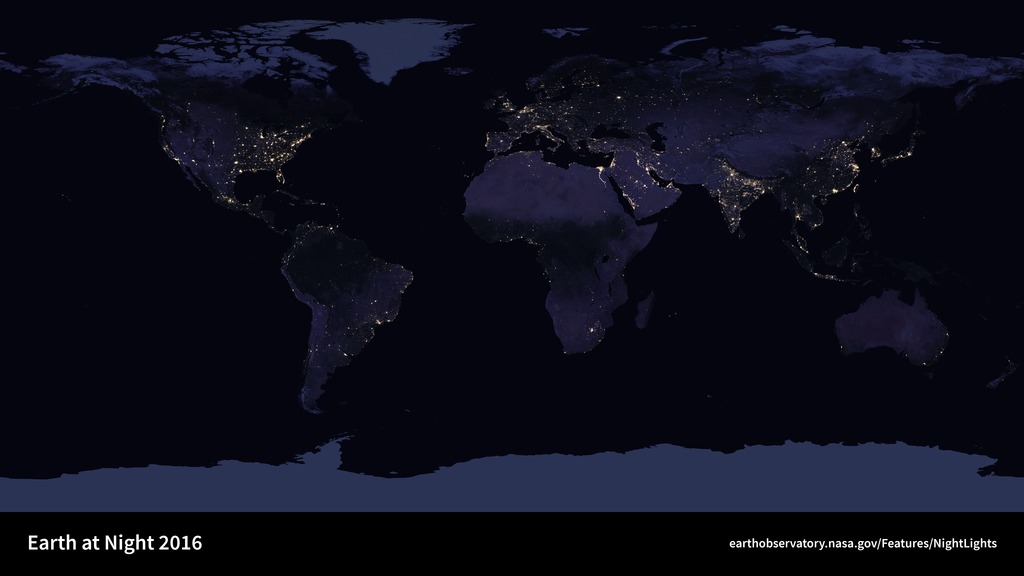
Behind the lights is a world organized around energy. NASA Black Marble, 2016 nighttime-data composite. Credit: NASA Goddard Space Flight Center.
The material ledger requires reopening that question. Through the lens of free energy, maintaining a system requires usable differences and conditions that allow those differences to do work. The novel locates the difference in the physical laws of two universes. As people obtain energy, they also change the conditions supporting that means of obtaining it.
The ledger must therefore extend from a machine on Earth to the channel's other end and the interior of the Sun. If we look only at electricity entering daily life, the benefits are clear. A longer timescale and wider boundary reveal how today's gains may affect tomorrow's survival.
The difficulty is that before the consequences become clear, the benefits have acquired weight of their own. Livelihoods, work and reputations depend on them. The original question was whether it could be used; the later question is whether we can still afford to stop using it.
Here dependence in the material ledger starts changing the information ledger: the greater the cost of acknowledging a fact, the more we may wish it were not true.
Do we believe in what keeps us alive?
When Lamont raises the danger, he confronts a world already benefiting. Hallam's reputation rests on the electron channel, and politicians must preserve society's comfortable life. A judgment about the Sun also affects how they understand their achievements and what responsibilities they must now bear.
Bayesian updating asks for something simple: when the evidence changes, revise the judgment. Yet the novel shows how far evidence must travel before judgment is reached. Which questions deserve research, who may raise objections and which results receive serious examination may all be influenced by existing dependencies.
This cannot be reduced to a conflict between a hero and fools. Lamont has resentments and obsessions of his own, and wants to prove Hallam wrong. His motives cannot establish his theory, but neither are they a reason to refuse to examine it. A claim must be able to leave the person making it and undergo independent comparison and testing.
Society faces another difficulty that no experiment can easily settle: if the most direct proof must wait for the Sun to explode, waiting for certainty itself carries risk. Continuing and stopping both change the future before the evidence is complete. After updating a belief, a choice remains: how much immediate cost are we willing to bear to avoid a possible loss?
This is where I see the ledgers joining. Maintaining life requires energy; changing a way of life also requires resources and time. The fewer alternative paths a society has, the harder it becomes to accept knowledge demanding change. Making an update possible takes better evidence, but also a route people can actually take.
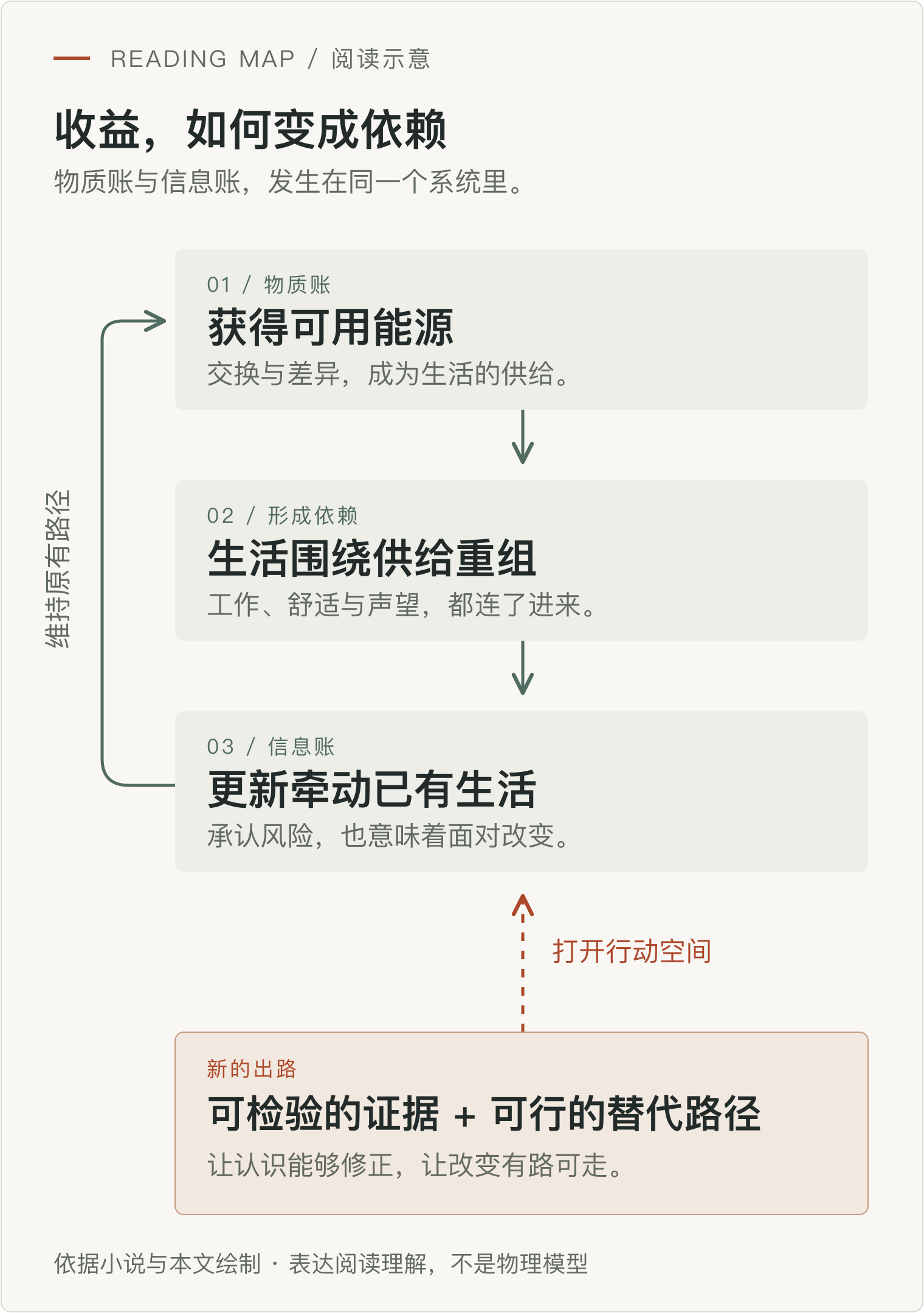
The two ledgers operate within the same system. An original reading diagram based on the novel and this essay, not a physical model.
But for whom should that route be found? From Earth alone, the question can still contract to how we preserve our energy and our Sun. Dua makes that scope inadequate.
Dua turns the other end into a world
The parallel universe is no longer merely an address at the other end of an exchange apparatus. Dua lives there, with partners, children and an aging home. The channel is a matter of survival for her world, yet she gradually realizes it may destroy life on the other side.
She wants to prevent the danger while living within the same dependency. Who bears the cost becomes more than a technical question: the means by which we maintain ourselves may endanger the conditions others need to exist.
Lamont on Earth and Dua in the parallel universe both try to send warnings across this relationship. Their difficulties mirror one another. Matter can already be exchanged, yet the danger may not be understood together, much less lead to a shared decision. The capacity to connect two worlds has moved far ahead of the capacity to bear the consequences together.
Dua's situation takes the problem deeper still. The Elder she, Odeen and Tritt finally merge into is Estwald, the very person she wants to stop. The opponent she placed outside herself belongs to the same course of life as she does.
That turn makes it hard for me to blame the danger only on another group's stupidity. The novel does not explain in detail how every feeling survives the merger. It leaves a sharp question: when a new we forms, with greater knowledge and a larger role, do the pain and responsibilities once felt retain the same weight?
A whole can possess stronger powers of judgment without thereby being assumed more willing to care for every life within it. Knowing what is happening, caring who gets hurt and being willing to change are three things that must each hold. Dua keeps them closely joined; that connection still needs to be preserved in a larger system.
A way forward must therefore do more than restore safety to Earth. It must bring life at the other end into account. Otherwise, we have simply cut the ledger off once more at a point favorable to ourselves.
A way forward must open both ledgers
Denison and Selene's research on the Moon pursues the question outward. If exchange between two universes creates danger, could a third universe with different physical conditions allow another channel to offset the original effect?
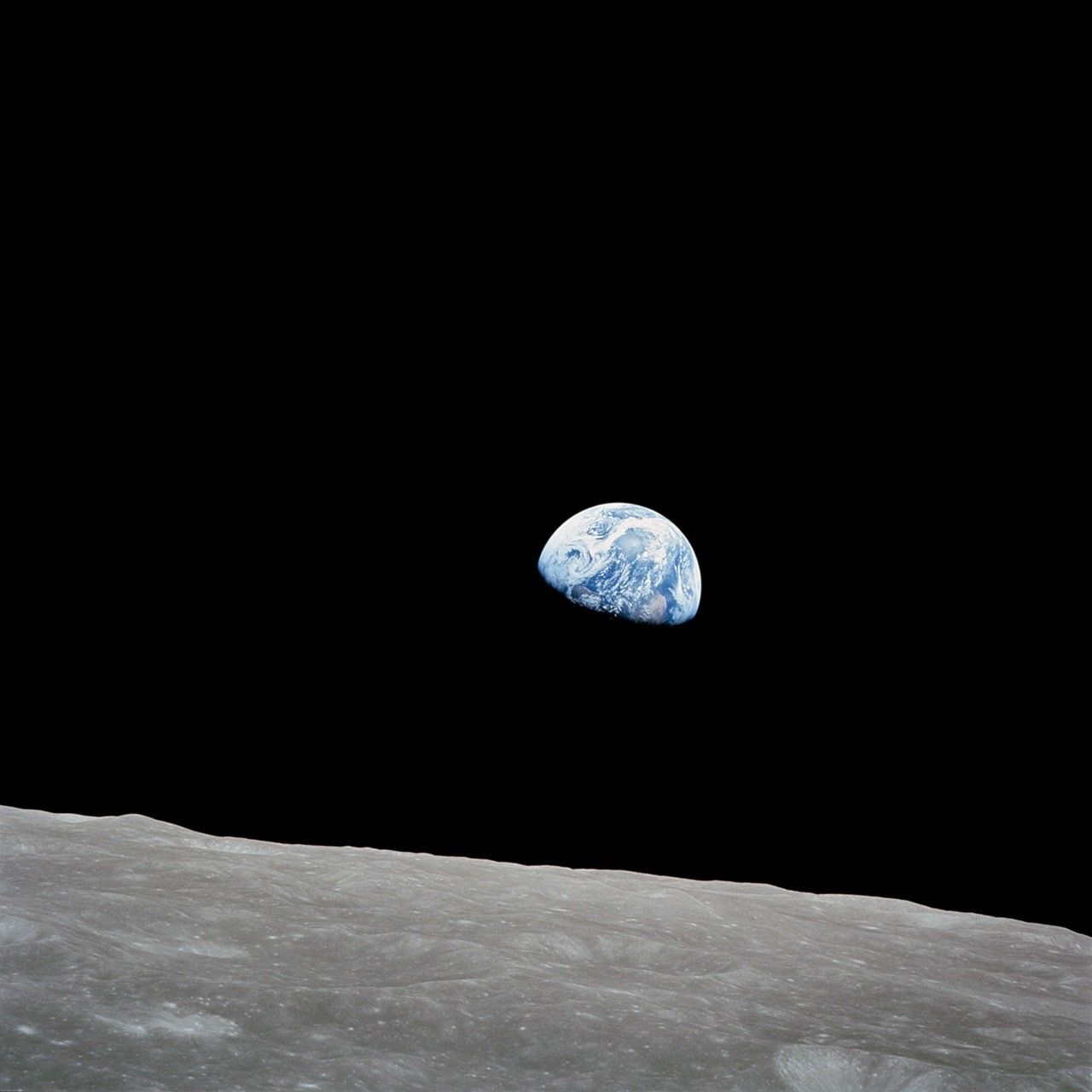
From outside a world, its boundaries become visible again. Earthrise, Apollo 8, December 24, 1968. Photograph: NASA / Bill Anders. Source: NASA original imagery.
This changes more than a technical proposal. Previously, acknowledging the risk seemed to mean surrendering a way of life already depended upon. Once another possibility appears, confronting the risk no longer necessarily involves losing everything in the same way. Options in the material ledger change, giving updates in the information ledger more room for action.
That does not mean warnings should be admitted only after an alternative is ready. The risk Lamont identifies deserves independent examination. It points to something else: helping a system acknowledge an error and enabling it to correct that error require work together.
New options also emerge from widening the scope of judgment. Bayes helps us adjust the weights of existing hypotheses as evidence arrives; it does not list every path we have yet to imagine. Selene and Denison bring experience from different positions together, then test imagination through experiment, allowing the range of choices to change.
The novel has now connected the ledgers into a loop. We obtain energy according to our understanding of the world and organize life around that means of obtaining it. Life forms dependencies, and those dependencies influence which understandings can be accepted. To leave the loop, we need to expand both the consequences we can see and the choices we can make.
The appearance of a third universe does not end that loop forever. The new channel still changes the worlds at either end. The characters believe the cosmic egg contains no life and are optimistic about its future. As a reader, I want to leave the original question with the new proposal too: how far have we looked, and which consequences have yet to enter our judgment?
My framework can follow free energy to ask about the conditions of continued existence, and Bayes to ask how understanding is revised. It cannot directly decide whose future matters more. Entropy and relative entropy have their physical and informational meanings under specified conditions; neither can turn different lives' fates into a single account whose entries simply cancel. Only by continuing to see concrete lives can the accounting remain connected to the world it seeks to explain.
The distance The Gods Themselves reveals therefore contains more universes, but also a harder capacity to acquire: to reconsider the relationships we inhabit after power has already created a way of life, and that life has formed dependencies.
When our power reaches another world, can our understanding and responsibility reach it too?
Reading basis: Isaac Asimov, The Gods Themselves. The cross-universe mechanism is a fictional premise; the discussion of cost, updating and the boundaries of life is a reading interpretation.
Reading edition: Jiangsu Phoenix Literature and Art Publishing House, 2014; translated by Cui Zhengnan. Cover extracted from the reading EPUB; rights remain with the original rights holders.