
Seveneves: Taking the Ability to Make a World into Space
How compelling a reason does humanity need to move into space? Seveneves offers an answer that is almost impossible to refuse: when the world beneath our feet is about to be lost, somewhere beyond it becomes a place we must reach. As I read, though, another question increasingly held my attention: when we leave Earth, how much of our ability to sustain life, repair tools, and make things anew can we take with us?
This connects two thoughts I had while reading. A global crisis might catalyze space development, while the robotics and manufacturing capabilities we accumulate today might determine how far that mobilization can go. Dinah makes the distance between them tangible: between deciding to depart and being able to stay lie countless small things that someone has to make work.
A crisis brings the future forward
After the Moon breaks apart, the coming disaster acquires a trajectory people can try to predict. Spaceflight becomes a matter of survival that requires society to reallocate its resources. Plans that could once be postponed suddenly have deadlines. Investments that were difficult to justify acquire a reason.
Through the information ledger, this is a dramatic update. People had assumed that Earth would continue to support their lives. New evidence undermines that premise, changing the relative importance of many choices. Technology may not have advanced at that moment, but the costs people are willing to bear for it have changed.
I can therefore understand the idea of crisis as a catalyst. It can accelerate decisions, concentrate scattered attention on a few goals, and bring resources to efforts long starved of investment. Yet willingness to pay and the ability to deliver are different things. A crisis can make factories run around the clock; it cannot remove the need to qualify materials, expose failures, or allow engineers to gain experience.
The cruelty of Seveneves lies partly here: the force driving humanity to accelerate is also destroying the conditions that support that acceleration. Industry on the ground, supply networks, research teams, and the time to try again after failure all face an endpoint. Who gets to leave, who commands, and which plans receive priority remain contested despite the common danger.
A crisis can make many things begin sooner, while leaving many others too little time to mature. The survival story the novel builds around this does not establish that real space development requires a catastrophe. It asks what people already have in hand by the time everyone is finally willing to act.
That question soon takes a painfully practical form: the space station still has room for more people, but its life-support systems cannot support more breathing.
How much of the cost does Earth hide from us?
I remembered the book's carbon dioxide scrubbers and toilets. They turn the question of how many more people can fit into a set of ongoing material processes: air must be treated, water circulated, waste handled, and heat from equipment rejected. Each additional person adds to the work these processes must do every day.
On the ground, we rarely account for life at this level. Ecosystems and extensive infrastructure jointly provide many of its conditions, beyond our individual field of view. In orbit, dependencies once hidden in the background become pipes, filters, radiator panels, and mass that must travel with us.
My material ledger begins here: what resources maintain a system, how does it use available energy, and what does it dissipate along the way? Free energy helps me ask about the conditions for doing work, but a space station's continued operation also depends on materials, equipment, transport, and time. Collapsing them into a single energy figure would obscure the actual constraints.
In the novel, two seemingly neighboring orbits can require an expensive change in velocity to connect because they occupy different planes. This reminds me that having resources nearby is not enough. Where they are, what state they are in, and whether they can be moved to where they are needed all affect their availability.
Likewise, taking many finished products does not mean taking the world that produced them. Dinah's robots break down; they must be retrieved and have chips replaced. That is a workable arrangement while resupply continues. Once support from the ground disappears, the supply chain previously hidden behind each robot becomes part of the limit on its working life.
This changes how I see the paperweights made from metal smelted in space at the beginning of the novel. Their commercial value is limited, but they mark a short path that has been connected: find material, process it, and make something. For that path to support human life, maintenance, spares, and further production must gradually be added.
Along with inventory, humanity can carry ways of continuing to work after inventory runs out. Dinah's work occupies precisely this junction.
Dinah takes a small piece of industry with her
Her robots are initially designed around an iron-rich asteroid. Electromagnets on their feet provide attachment; cutting heads and grinding wheels handle rock and metal. When the mission turns toward ice, some of the premises behind those useful designs cease to hold. Magnets cannot grip ice in the same way. The robots must find new ways to anchor themselves, move, and process material.
I like this change. It prevents “robotics technology” from jumping as an undifferentiated capability from one task to the next. Engineers have to identify which experience can transfer and which interfaces must be redesigned. Biomimetic forms have their uses, but what makes any form work is its relationship with materials, forces, and tasks.
On Ymir, many robots work out of sight. They anchor themselves to ice and grind it into fine particles, which other robots carry to a conveyor system feeding the reactor. Heating turns the ice into steam, allowing it to contribute to propulsion. The ice provides propellant and the reactor supplies heat; a chain of processing and transport connects them.
These operations add another layer to my understanding of resources. Resources become usable capabilities through a reliable process. Between a large block of ice and a propulsion system with a sustained supply lie anchoring methods, tool wear, particle properties, feed rates, and ways to recover when any step gets stuck.
The work also continues after construction. In the novel, steam continually changes the shape of the ice nozzle, and robots repeatedly repair it. Others reinforce the ice body. Manufacturing, use, and repair happen continuously on the same object. The spacecraft's ability to retain its shape is itself the result of work.
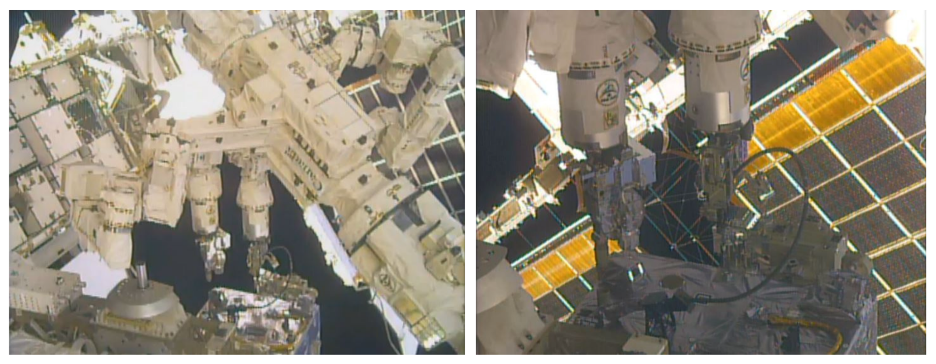
Performing an action also requires checking its result. During the 2020 RRM3 demonstration, Dextre used one arm to handle a cryogenic-fluid hose and the other to inspect the connection. These are real orbital operations, not a scene from the novel. Image: NASA.
These machines still need charging, maintenance, and spare parts. Reducing human extravehicular work does not make them cost-free labor. Their value must be assessed across the entire operation: can they reduce human exposure, allow limited maintenance capacity to support longer operation, and recover from failures?
The possibility I see in Dinah therefore reaches a little further than having machines do work for us. Humanity might carry a small piece of industry to a place where it could not previously live, gradually bringing local materials into its own production processes. But the more that industry can alter its surroundings, the more it needs to know what those surroundings have become.
Each operation changes the conditions for the next judgment
As Ymir approaches Earth, its planned trajectory encounters an atmosphere that has changed. The disaster has heated and expanded it; the person who planned the maneuver has not been able to keep sufficiently abreast of the latest conditions. An action carefully planned under earlier circumstances enters a different world.
This concerns me more than a simple calculation error. Information can become outdated, and a correct answer has a domain of validity. By the time new information arrives, propellant already spent and a trajectory already entered constrain the remaining options.
The information and material ledgers meet here: we act on a model, and action consumes resources. When new evidence calls for a revised judgment, whether we can afford to implement that revision determines how useful the knowledge can still be.
Bayesian updating reminds me to adjust judgments with evidence. Sometimes, though, the assumptions that make the model work must themselves be reopened. Ymir's ice body changes as it contacts the atmosphere; its shape changes, and so do the forces acting on it. Continuing to treat it as a fixed-shape object and calculating the old model more precisely may not bring us closer to reality.
For a robot, this means checking repeatedly: is the material it has gripped still secure? What does the surface it just machined look like? Has the tool worn down? Did the completed action produce its intended result? The next step must account for the actual state left by the previous one as well as the original drawing.
Relative entropy can describe differences between judgments once probability distributions have been specified. In engineering, the consequences of a mistaken judgment still require a separate account: damage, rework, or the loss of an opportunity to act. They cannot simply be equated with a relative-entropy value. My framework supplies questions here: which discrepancies were detected, were they detected early enough, and is correction still possible?
Maintaining this process of updating is also human work. Dinah spends day after day staring at code, sometimes having to remind herself of the disaster she faces. An overwhelming sense of urgency cannot sustain meticulous attention indefinitely. Records, checks, handoffs, and assigning stable tasks to machines therefore belong to survival capability too. Tired people need a working system that can catch what they miss.
This brings me back to less conspicuous forms of accumulation in engineering today: why an interface was specified a certain way, what a failure revealed, and which judgments need to be checked again after a part changes. If that information survives, manufacturing capability has a chance to grow as the task changes.
From today's work toward that small piece of industry
At this point, I begin to see today's work in robotics and hardware manufacturing differently: what we accumulate could become part of a future capability to manufacture robots for orbital work. I want to retain this thought as a direction worth testing, gradually giving it concrete substance.
Dinah offers a straightforward lesson: when faced with new materials and environments, can we start from the task, reorganize mechanics, actuation, sensing, control, and processing methods, then revise them through actual operation? When a robot moves from iron ore to ice, what transfers is the ability to understand the task and adapt the tools. The original design must be tested again.
Returning to today's work, what I most want to accumulate is a process that can be carried through repeatedly: turn requirements into structures and interfaces, turn designs into things that can be assembled, and feed discrepancies from manufacturing and operation back into design judgments. Retaining the basis for each step makes it possible to know where to begin changing things when the constraints differ next time.
This connects with my earlier essay on functional thinking. Making design judgments transferable means giving others both the result and visibility into the conditions on which it depends. When materials, loads, or maintenance methods change, an old solution can then be revised on a reasoned basis, without having to infer everything again from a finished object whose rationale has been lost.
Moving into space adds further demands. Vacuum, thermal conditions, radiation, limited resupply, and communication constraints all require renewed verification for the particular mission. Building robots on the ground is one part of the path. Manufacturing, assembling, and repairing them in orbit also requires processing equipment, feedstock, measurement, and quality control. Whether a capability transfers depends on connecting these steps.
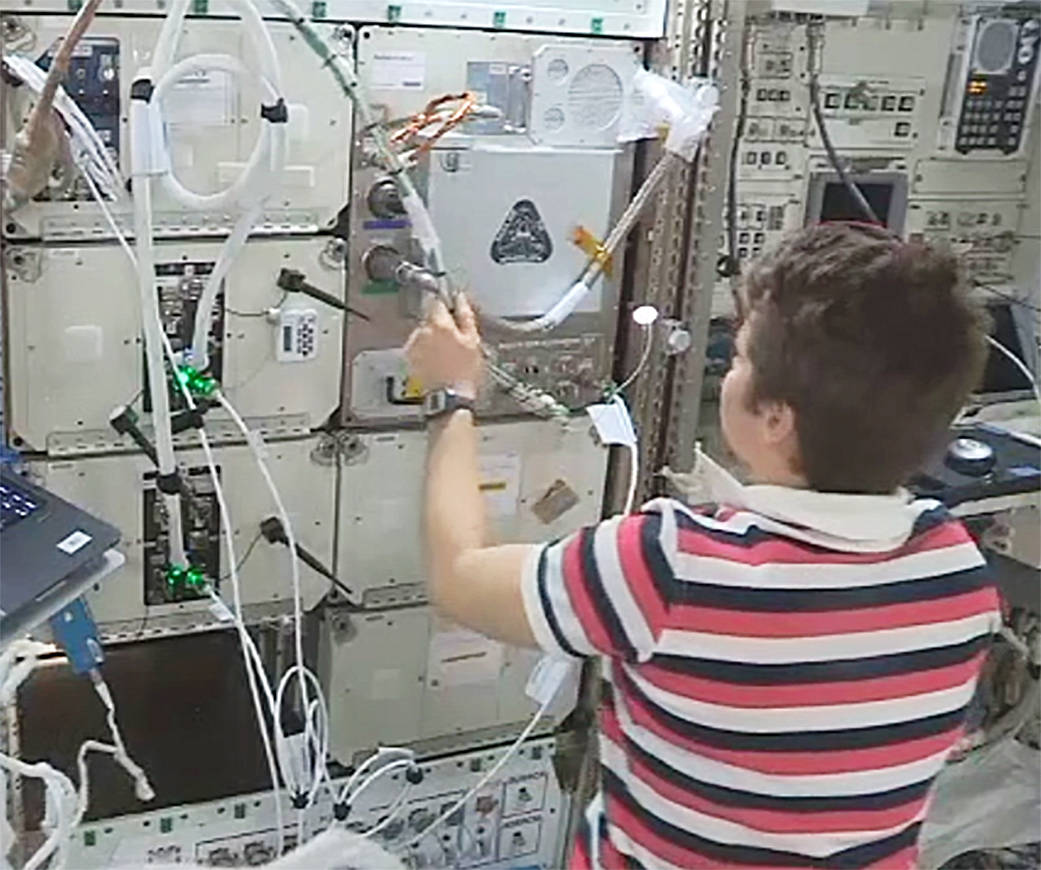
Returning material to manufacturing is one step toward reducing resupply dependence. Installed on the International Space Station in 2019, Refabricator was designed to demonstrate combined plastic recycling and 3D printing. A single experimental unit remains a long way from a complete self-sufficient manufacturing system. Image: NASA.
I am therefore willing to ground the distant ambition in a small test: when task conditions change, can we more quickly identify what must change, make it, and confirm that the change works? A little further along, can we repair a broken tool or produce a substitute when the original part is unavailable? Each increment of that ability leaves a little more room for future choices.
The later part of Seveneves moves five thousand years ahead. Looking back across that span, small early tools and technical habits have helped shape later life. The novel gives them a path of continuity; the paths available in reality still have to be tried by us.
What I most want to bring back from the book is the patience to make those attempts. While Earth can still support resupply, collaboration, and repeated trials, we possess a resource that becomes extraordinarily expensive in a catastrophe: time for capabilities to mature.
If crisis finally makes people decide to depart, ordinary manufacturing and verification today determine what they can take when they leave.
The space future I want to see includes more and more work that can be done locally. People can live there, tools can be repaired there, and new ideas can be made there. Moving toward that future may begin with making one particular thing properly today—and retaining the capability to make it again next time.
Reading basis: Neal Stephenson's Seveneves, in the three-volume Chinese edition, and the reading notes supplied for this essay. The discussion focuses on the early mining and life-support work, the Ymir and Endurance episodes, and technological continuity five thousand years later. The lunar catastrophe and Ymir's engineering details are treated as fictional premises. The discussion of crisis and the transfer of manufacturing capabilities consists of reading interpretations and future possibilities. The two illustrations show only the real technology demonstrations identified in their captions.